B2B marketplace software: build, buy or white-label, judged on what growth needs later
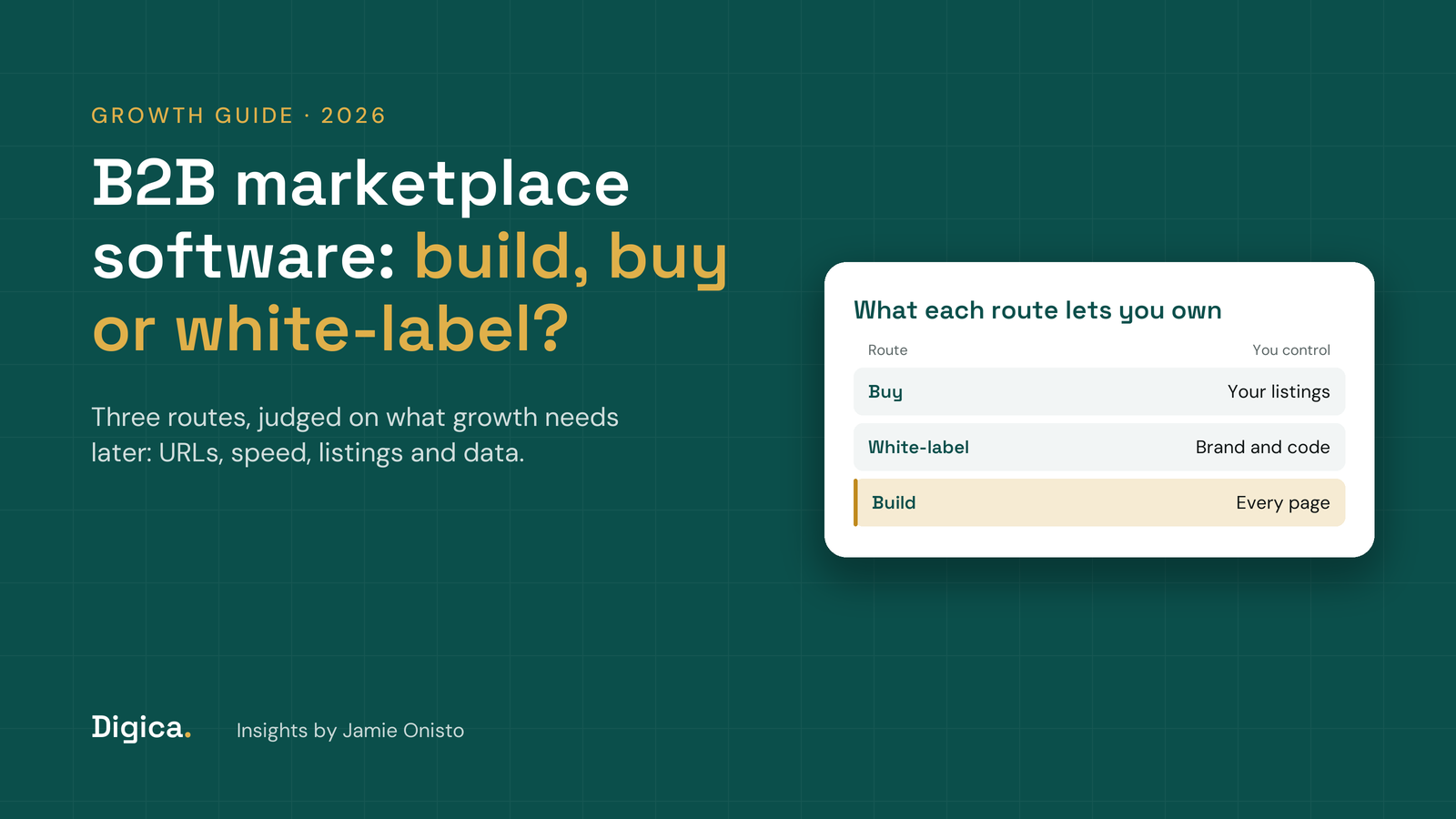
Choosing marketplace software is the first big decision a B2B marketplace founder makes, and the one most often judged on the wrong test. Founders compare checkout flows, seller dashboards and launch dates. Twelve months later the question that matters is different: can buyers find the listings on Google and in AI answers, and can the platform grow to thousands of category pages without breaking?
The three routes look similar on a feature sheet. You can buy a hosted B2B marketplace platform from $39 a month while you build, license white-label code from $725 a year, or commission a custom build that one development agency, RaftLabs, prices from $40,000 for a minimum viable product. What separates them is not the launch. It is how much of the discovery layer you control once growth depends on it: URLs, rendering, page speed, structured listings, analytics and integrations.
This guide is for founders choosing a B2B marketplace platform. It defines build, buy and white-label, judges each on what growth needs later, and ends with a decision framework. It draws on our work on marketplace platform builds, where we design the category and listing layer that search engines read, and sits alongside our B2B marketplace growth strategy.
Quick Navigation
- What marketplace software has to do
- Build, buy or white-label: the three routes
- Buy: hosted B2B marketplace platforms
- White label marketplace software
- Custom B2B marketplace development
- The growth test: five things every route must pass
- B2B marketplace software, side by side
- What switching platforms costs later
- Three failure scenarios
- Choosing a B2B marketplace platform: a decision framework
- FAQ
- Related Articles
What marketplace software has to do
The short answer: marketplace software runs two layers. The transaction layer handles accounts, listings, orders, payments and payouts. The discovery layer decides how buyers find any of it: category pages, listing pages, search, filters and internal links. Most platform comparisons judge only the first.
The transaction layer is where vendors compete, and it is mostly solved. Every serious B2B marketplace platform can onboard sellers, take a request for quote, apply buyer-specific pricing and pay out. Our comparison of B2B ecommerce marketplace platforms ranks seven of them on exactly those features.
The discovery layer is where B2B marketplaces stall. A B2B marketplace is a page-generation machine. Done well, it produces thousands of category, location and listing pages, each answering a real buyer search. Done badly, it produces thousands of near-duplicates that search engines crawl and then ignore. The software you choose sets the ceiling on which of those you get, because it decides who controls the URLs, how pages render and what data each listing exposes.
Our view: pick marketplace software on the discovery layer first and the transaction layer second. Transaction features can be added later. A platform that hides your listings from search engines has to be replaced.
Build, buy or white-label: the three routes
The short answer: buying means renting a hosted platform the vendor runs, white-label means running licensed software under your own brand, and building means owning custom code. The trade is speed against control.
- Buy. A hosted software-as-a-service (SaaS) B2B marketplace platform such as Sharetribe, Mirakl, Marketplacer or Arcadier. The vendor hosts it, updates it and sets the limits on what you can change. You pay a subscription, and some vendors also charge setup or usage fees.
- White-label. Marketplace software you run under your own brand and domain. It comes in two forms: licensed, self-hosted code such as CS-Cart Multi-Vendor or Yo!Kart, where you get the source code and run hosting and updates yourself, and hosted, unbranded SaaS such as Sharetribe's Live plan, which the vendor describes as having no Sharetribe branding anywhere.
- Build. Custom B2B marketplace development, by your own team or an agency, usually on open-source frameworks and third-party services for payments and search. You own every line, and every line is yours to maintain.
The term "white label marketplace" causes confusion because it is also used for reselling another company's app store or SaaS catalog under your brand. That is a different product. In this guide it means multi-vendor marketplace software you run as your own.
Choosing marketplace software for a B2B marketplace?
In 30 minutes we look at your categories, your buyers and the platforms on your shortlist, and tell you which route we would take, and whether we are the right people to help.
The routes also blur. Sharetribe's Build plan gives full code access to its web template, so a team can start on a hosted platform and customize toward something close to a build. CS-Cart includes full code access on its entry plan. The useful question is not which label a vendor uses, but which of the five growth needs below you will control.
Buy: hosted B2B marketplace platforms
The short answer: buying is the fastest route to a live B2B marketplace and the cheapest to start, but you inherit the vendor's choices on rendering, URLs and hosting. Check those before you sign, not after you rank.
Published prices sit at both ends of the market. Sharetribe charges $39 a month on its Build plan, which includes full code access and API access in test mode, and $199 a month billed yearly on its Live plan, with no transaction fees and 1 million usage credits a month before extra usage is billed. Arcadier, which says it powers more than 260 marketplaces through 150+ APIs, quotes a one-time setup fee plus monthly platform and maintenance fees, and says it does not default to transaction fees. Mirakl, which says more than 450 enterprises use it, publishes no price.
The bigger difference is architectural. Mirakl and Marketplacer sit behind an existing storefront. Mirakl describes itself as API-first, with pre-built connectors for SAP, Adobe, Salesforce, Shopify and VTEX. Marketplacer connects to Shopify Plus, BigCommerce, Salesforce Commerce Cloud and commercetools, adds marketplace capability without replatforming, and offers a Fast Start program to launch in 90 days. In both cases, URLs, rendering and search engine optimization (SEO) stay with the storefront you already run. That is a strength if your storefront is fast and crawlable, and a trap if it is not.
Sharetribe is the opposite case: it gives you the storefront. Its web template runs on a Node.js server that, in Sharetribe's words, enables server-side rendering to improve search engine optimization, and its documentation says serverless hosting platforms are not compatible with the template. That matters because Google's own guidance on JavaScript sites says server-side or pre-rendering is still a great idea, and that Google can only discover links that are HTML anchor elements with an href attribute (Google Search Central). A listing page that only appears after JavaScript runs waits in a rendering queue before it can be indexed.
What to check before you buy: whether category and listing pages are server-rendered, whether you can set your own URL structure, whether you can add structured data to listings, and what happens to your content if the vendor retires the product. Sharetribe's help center says customizing with code can cost "only a few hundred dollars" for simple changes and "tens of thousands" for complex ones, so price the changes your growth plan needs, not just the subscription.
White label marketplace software
The short answer: white-label marketplace software gives you your own brand and, in its licensed form, your own code, at a fixed price. You trade the vendor's hosting and updates for control, and that control is only worth having if someone on your side can use it.
Licensed, self-hosted white-label software is the cheapest way to own your code. CS-Cart Multi-Vendor costs $725 a year on its Standard plan, which includes full code access for customization, rising to $1,449 a year on Plus and $3,599 on Ultimate, with lifetime licenses at $3,590 for Plus and $7,990 for Ultimate. Yo!Kart sells self-hosted lifetime licenses with no recurring charges and no transaction fees: its GoQuick package costs $1,999 with a stated timeline of 5 to 7 working days, and its GoCustom package costs $6,249 with a timeline of 50 to 60 working days and a custom design for nine pages. Both include the web app's source code.
Owning the code means you can fix what a hosted platform will not let you touch: URL patterns, how filter combinations are handled, page templates, structured data and server-side rendering. It also means you own the hosting, the security patches and the upgrades. A licensed script that falls three versions behind is cheaper than a custom build and harder to maintain than either alternative.
Hosted white-label is the middle ground. Sharetribe's Live plan removes the vendor's branding and leaves hosting to Sharetribe; Arcadier offers white-labelled marketplaces on the same hosted basis. You get your brand and domain, but rendering and hosting stay the vendor's call.
Our view: licensed white-label software suits a founder with one or two developers who want to own the discovery layer without paying for a build. It suits nobody who plans to leave the code untouched, because then it is a hosted platform without the hosting.
Custom B2B marketplace development
The short answer: building gives you full control of every growth lever, at the highest cost and the slowest start. It wins when your B2B marketplace's advantage depends on something no platform does.
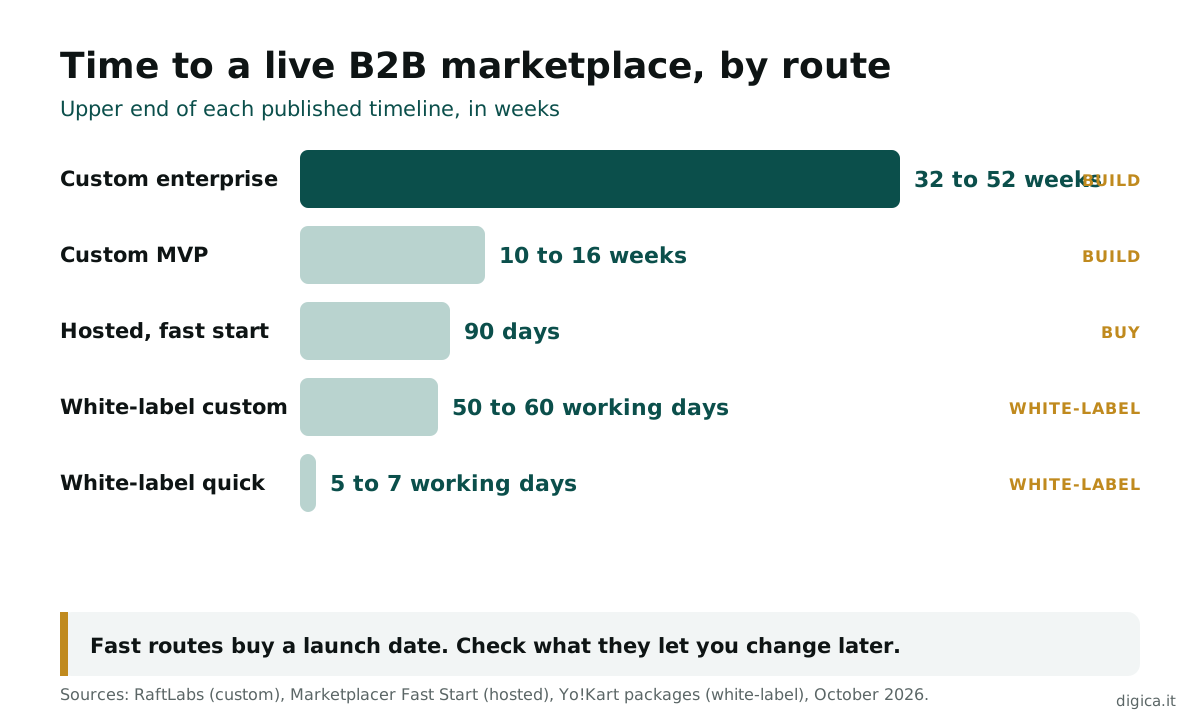
Every cost figure for custom B2B marketplace development comes from someone who sells builds, so read it as a quote, not a benchmark. RaftLabs, a development agency, prices a marketplace website at $40,000 to $80,000 for a minimum viable product in 10 to 16 weeks, $80,000 to $140,000 for a full-featured platform in 20 to 32 weeks, and $140,000 to $240,000 for an enterprise two-sided platform in 32 to 52 weeks. We could find no independent 2025 or 2026 benchmark, and estimates from other agencies vary widely.
What a build buys is the right to design the discovery layer around your buyers. A B2B marketplace for industrial parts may need pages for every combination of part type, standard and region where buyers actually search, with specification data rendered as structured listings. A B2B marketplace for professional services may need location and sector pages that pull live supplier counts. No hosted platform ships those templates, and white-label code has to be bent to produce them.
The risk is that the build finishes and the team moves on. Custom code needs owners for performance, crawling and analytics, or it degrades like any other software. A build only beats a bought platform if the team that ships it keeps working on the pages buyers land on.
Our usual arrangement is that your own development team builds from our specification and brief, which keeps the knowledge with you. Where you would rather not carry the work, our in-house developers build the discovery layer instead: categories, listings, search and navigation. Transactions and accounts usually stay with your product team, whichever route you choose.
The growth test: five things every route must pass
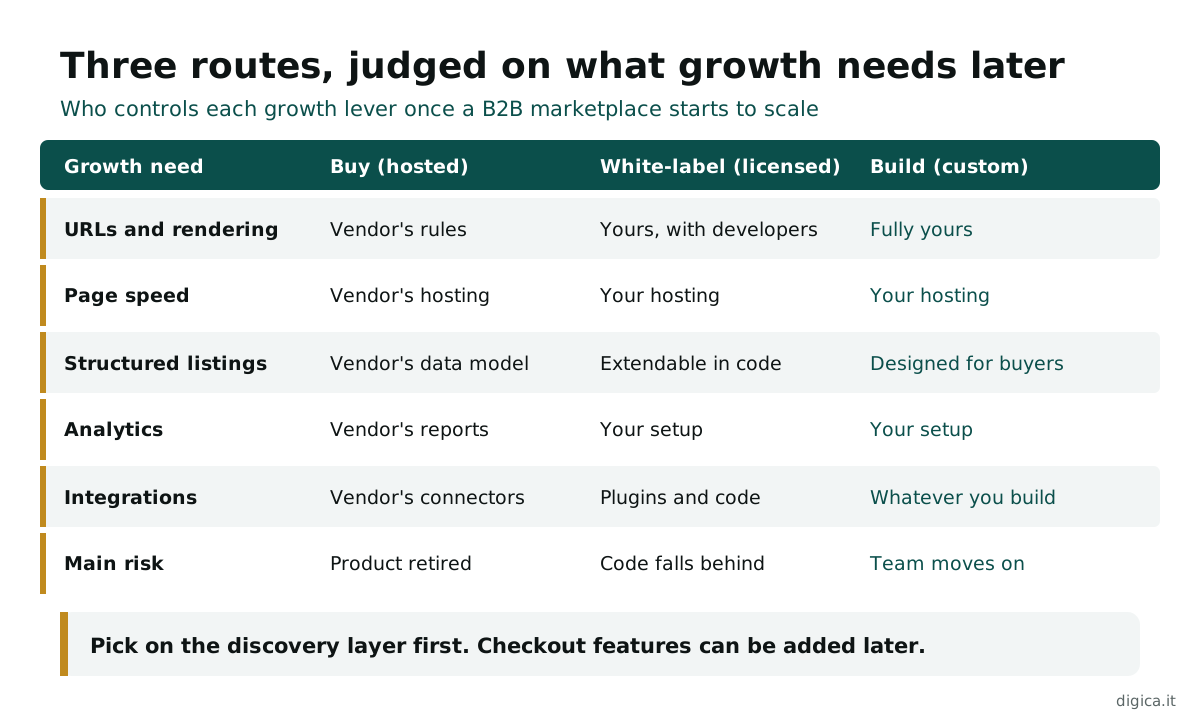
The short answer: whatever you choose, it has to let you control five things once growth depends on them. URLs and rendering, page speed, structured listings, analytics, and integrations.
- URLs and rendering. You need to set your own URL structure for categories, locations and listings, and serve those pages fully rendered. Hosted platforms often fix path prefixes; headless or custom front ends remove that limit.
- Page speed. Google's Core Web Vitals set three thresholds at the 75th percentile of page loads: Largest Contentful Paint within 2.5 seconds, Interaction to Next Paint at 200 milliseconds or less, and Cumulative Layout Shift at 0.1 or less. Few sites meet them. The HTTP Archive's Web Almanac 2025 found that only 48% of mobile websites and 56% of desktop websites passed all three (HTTP Archive). A listing-heavy B2B marketplace, with images, filters and third-party scripts on every page, starts at a disadvantage.
- Structured listings. Each listing should carry its key attributes as data, not just prose: specifications, location, certifications, lead times. That is what lets you build useful category pages, add structured data and give AI answer engines something to quote. Google distinguishes merchant listings, for pages where buyers can purchase, from product snippets, for pages where they cannot, which covers most request-for-quote listings.
- Analytics. You need to see which category pages bring buyers who send requests, not just visits. That means event tracking on requests, sign-ups and seller responses, with access to the raw data.
- Integrations. B2B buyers and sellers live in enterprise resource planning (ERP), product information management (PIM) and procurement systems. A B2B marketplace platform that cannot exchange catalogs, prices and orders with them caps how large your sellers can grow.
None of these shows up in a demo. All five decide whether the category pages that earn search traffic can exist on your platform at all.
B2B marketplace software, side by side
The short answer: buying is cheapest to start and least in your control, white-label sits in the middle, and building costs most and controls everything. The table sets out where the cost and the risk sit for each.
Build, buy and white-label marketplace software compared on cost, time to launch, control of growth needs, main risk and best fit
| Aspect | Buy (hosted platform) | White-label (licensed code) | Build (custom) |
|---|---|---|---|
| Starting cost | From $39 a month while building on Sharetribe; enterprise platforms quote | From $725 a year (CS-Cart) or $1,999 once (Yo!Kart) | $40,000 to $80,000 for an MVP, per RaftLabs |
| Time to launch | Days to 90 days, depending on platform | About 1 week to 12 weeks, per vendor packages | 10 to 52 weeks, per RaftLabs |
| URLs and rendering | Vendor's rules, check before signing | Yours to change, if you have developers | Fully yours |
| Page speed | Vendor's hosting and template | Your hosting and your tuning | Your hosting and your tuning |
| Structured listings | Within the vendor's data model | Extendable in code | Designed around your buyers |
| Integrations | Vendor's connectors and APIs | Plugins and custom code | Whatever you build |
| Main risk | Vendor retires or reprices the product | Code falls behind on updates | Team moves on and the build decays |
| Best for | Validating demand in one category | Founders with one or two developers | Advantage that no platform supports |
Every price is the vendor's or agency's published figure in October 2026. Hosted platforms add usage and setup fees, and every route adds hosting, payments and the work of building content, which no software price includes.
What switching platforms costs later
The short answer: switching platforms after you rank costs a rebuild plus a period of lost search traffic, and the second cost is the one founders forget. Choose a route you can grow on for at least three years.
Google's guidance on site moves says to expect ranking fluctuations while it recrawls and reindexes a site, that a small to medium-sized website can take a few weeks for most pages to move, and that every old URL should permanently redirect to its new one. For a B2B marketplace with thousands of category and listing pages, that means a complete URL map before launch day. Miss it, and the pages that earned rankings return errors while the new ones start from nothing.
Will your platform's pages ever rank?
A growth audit crawls your B2B marketplace the way search engines and AI crawlers do, and shows which category and listing pages they can read, and which they never reach.
The switch is not always your choice. Sharetribe replaced its original Go product with a new platform in October 2023. Its help center says legacy Go marketplaces were hosted for six months and then shut down, and that the content and styles of Go's static pages were not migrated. Every founder on that platform had to move on the vendor's timetable. That is not a criticism of one vendor. It is the risk built into any rented platform, and the reason to keep your content and URL structure in a form you can take with you.
The cheapest protection is ownership of three things from day one, whichever route you choose: your domain, your URL structure and an export of your listing data. With those, a platform change is a migration. Without them, it is a restart.
Three failure scenarios
These are the patterns that recur when a B2B marketplace chooses software on the launch rather than the growth.
- The filters that ate the crawl. A B2B marketplace for building materials launches on a platform that turns every filter combination into a new URL: material, grade, region, price band, in any order. Search engines spend their time on millions of near-identical pages and reach the real category pages late. Google calls faceted navigation "by far the most common source of overcrawl issues" that site owners report to it (Google Search Central). Choosing a platform that lets you decide which filter pages get indexed would have kept the crawl on pages buyers search for.
- The listings nobody could see. A B2B marketplace for laboratory services builds a fast single-page app. Listings load after JavaScript runs, and links between categories are buttons, not HTML links. People see a polished product. Search engines see a near-empty shell and discover listings slowly or not at all. Server-rendered category and listing pages from launch would have cost little more and saved a year of invisible inventory.
- The white-label script nobody owned. A founder licenses marketplace code to save on a build, launches on the default templates and never changes them. Two years on, the code is three versions behind, the URLs follow the script's default pattern, and the team that could change them has left. A hosted platform would have cost about the same and stayed updated; a licensed one only pays off with a developer who keeps working on it.
Each founder chose software that worked on launch day. None of them checked what the platform would let them change once growth depended on it.
Choosing a B2B marketplace platform: a decision framework
The short answer: match the route to how certain your demand is, how many developers you have and how many pages your growth plan needs.
- If you have not yet proven demand in one category, buy a hosted platform with server-rendered pages, such as Sharetribe, and spend the difference on recruiting your first 50 sellers.
- If you already run a fast, crawlable B2B storefront and want to add third-party sellers, buy a platform that sits behind it, such as Mirakl or Marketplacer, so URLs and rendering stay where they already work.
- If you have one or two developers and a budget under $10,000 for software, license white-label code such as CS-Cart or Yo!Kart and plan the URL structure and templates before you launch.
- If your growth plan needs more than 1,000 category or location pages, confirm before you sign that you can control URLs, filter indexing and structured data on every template. If a platform cannot, it is the wrong platform, whatever its features.
- If your advantage depends on data or workflows no platform supports, build, and budget for a team that keeps working on the pages after launch.
- If a vendor cannot tell you how its category and listing pages render without JavaScript, do not shortlist it.
Planning the build of a B2B marketplace?
We design the category, listing and search layer that search engines and AI crawlers read, for your developers to build from our brief or for our in-house team to build for you.
The discovery layer is where the return shows. We have seen a water and wastewater marketplace reach 10x+ organic impressions within six months, and a B2B agency marketplace grow from five people to 40,000+ listed agencies and 1M+ monthly users. Neither result came from choosing the right checkout. Both came from pages buyers could find.
The number to take into your next board meeting is the cost of switching, not the cost of starting. A platform that saves $40,000 at launch but forces a rebuild at $80,000 to $140,000 for a full-featured platform, on RaftLabs' figures, plus weeks of ranking fluctuation, costs more than it saves, and it does so at the moment growth is working. The payback on choosing a route you can grow on is the rebuild you never fund.
FAQ
What is marketplace software? Marketplace software is the platform that runs a multi-vendor marketplace: seller onboarding, listings, search, orders, payments and payouts. For a B2B marketplace it also needs request-for-quote flows, buyer-specific pricing and integrations with buyers' and sellers' business systems.
What is a white label marketplace? A white label marketplace is marketplace software you run under your own brand and domain. It comes as licensed code you host yourself, such as CS-Cart Multi-Vendor or Yo!Kart, or as a hosted platform with the vendor's branding removed, such as Sharetribe's Live plan.
Should I build or buy a B2B marketplace platform? Buy if you are still proving demand, because a hosted platform launches in days or weeks for a monthly fee. Build when your advantage depends on data, workflows or page types no platform supports, and you can fund a team to keep improving the pages after launch.
How much does B2B marketplace development cost? Published figures come from vendors and agencies. Hosted platforms start at $39 a month while you build on Sharetribe, white-label licenses at $725 a year for CS-Cart, and one agency, RaftLabs, prices custom builds from $40,000 to $80,000 for a minimum viable product.
What is the best B2B marketplace software for SEO? The best B2B marketplace software for SEO serves category and listing pages fully rendered on the server, lets you set your own URL structure, controls which filter combinations get indexed and supports structured data on listings. Check all four on a vendor's live customer sites before you choose.
Can I move my B2B marketplace to a different platform later? Yes, but plan for it. Google says a site move can take weeks for most pages to settle, and every old URL needs a permanent redirect to its new address. Keeping your own domain, URL structure and an export of your listing data makes the move a migration rather than a restart.
Related Articles
- Marketplace platform build
- B2B marketplace growth strategy: what works in 2026
- Best B2B ecommerce marketplace platforms in 2026
- Category page SEO for marketplaces: the money page guide
- How to grow a B2B marketplace: a stage-by-stage guide
- B2B ecommerce strategy: the marketplace playbook
- GEO for marketplaces
- Liquidity is the only marketplace metric that compounds
Where this connects
This article is part of our B2B marketplace growth series. Browse more on the Digica blog.