B2B ecommerce strategy: the marketplace playbook for distributors and manufacturers
Every B2B ecommerce strategy for a distributor or manufacturer comes down to one choice that most guides skip: build your own webshop, launch your own B2B marketplace, or sell through someone else's. Each route has a different cost, a different speed and a different owner of the customer. Picking the wrong one first is the most expensive mistake in B2B ecommerce, because it takes a year to find out.
The pressure to choose is real. Digital Commerce 360 put US manufacturing and distribution sales at $15.12 trillion in 2025, up just 0.4%, while digital channels beneath that flat line grew at a double-digit pace. Buyers are moving online inside a market that is barely growing, which means digital share is won from competitors, not from new demand.
This playbook is for distributors and manufacturers deciding where to sell online. It sets out the three routes, what each costs and when each wins, with evidence from public filings, published fee schedules and our own work on B2B marketplaces and directories. It sits alongside our B2B marketplace growth strategy, which covers what happens once a B2B marketplace is live.
Quick Navigation
- What a B2B ecommerce strategy has to decide
- B2B vs B2C ecommerce: why the playbook differs
- B2B ecommerce benefits that show up in the numbers
- Route 1: your own webshop or B2B portal
- Route 2: launching your own B2B marketplace
- Route 3: selling through existing B2B marketplaces
- The three routes side by side
- B2B ecommerce best practices that apply to every route
- Three failure scenarios
- Which route first: a decision framework
- FAQ
- Related Articles
What a B2B ecommerce strategy has to decide
The short answer: where you sell online, who owns the customer relationship, and how much of the catalog you carry yourself. Platform, payments and integrations follow from those three decisions, not the other way round.
Most B2B ecommerce strategy guides start with the technology: which platform, which ERP connector, which search tool. That order is backwards. A distributor that picks a platform before deciding whether it will add third-party sellers often has to replatform two years later, when it decides it should have.
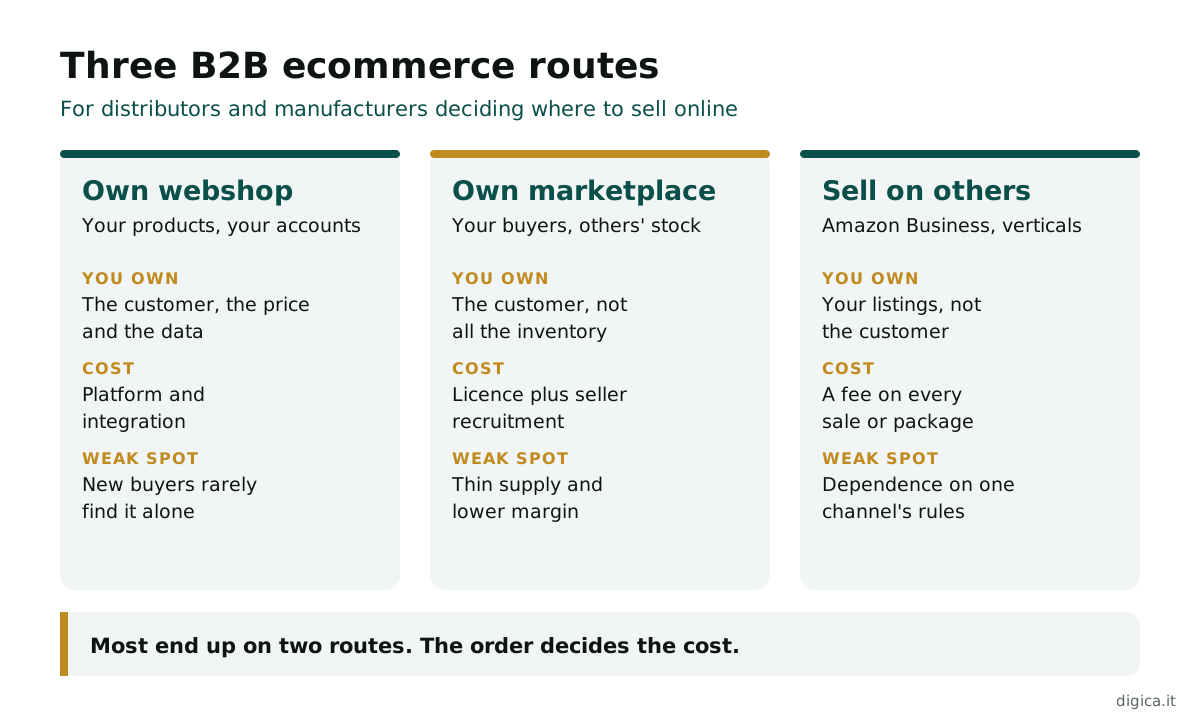
The three routes answer the ownership question differently. A webshop keeps everything: your products, your prices, your customer. Your own B2B marketplace keeps the customer but lets other sellers fill the catalog. Selling on an existing marketplace gives up the customer relationship in return for buyers you could not reach alone.
Our view: most distributors and manufacturers end up using two routes, not one. The decision that matters is which comes first, because the first route sets the data, the team and the budget for the next.
B2B vs B2C ecommerce: why the playbook differs
The short answer: B2B buyers buy in larger orders, on negotiated prices and payment terms, often with approvals, and they reorder. B2C ecommerce optimizes the first checkout; B2B ecommerce optimizes the tenth.
That changes what a good B2B ecommerce site needs. Customer-specific prices and catalogs, quotes for large orders, purchase orders and invoice payment, several users per account with spending limits, and fast reordering matter more than product photography. A B2B buyer who cannot see their contract price will call a sales rep, which defeats the point of the site.
It also changes how buyers find you. B2B buyers research for weeks, compare suppliers and defend the choice internally. McKinsey's 2024 B2B Pulse found buyers now use an average of ten channels to interact with suppliers, and that more than half would switch supplier after a poor experience across them. A webshop that works but is invisible in search, on marketplaces or in AI answers loses to a competitor that is present on all three.
Selling to businesses is also less forgiving of gaps in the catalog. A procurement team that can buy 80% of a project's parts from one supplier will often buy the rest from a supplier that has 100%. That is the commercial logic behind every distributor marketplace.
B2B ecommerce benefits that show up in the numbers
The short answer: buyers prefer to buy without a rep, ecommerce becomes the largest sales channel once offered, and large orders are moving online too.
Gartner's 2025 survey of 632 B2B buyers found 61% prefer a buying experience without a sales rep (Gartner). That does not remove the sales team; it changes its job from taking orders to helping on the complex ones.
McKinsey's 2024 B2B Pulse found that for B2B companies that offer ecommerce, it is now their largest revenue channel, at 34% of sales. Forrester predicted that in 2025 more than half of B2B purchases of $1 million or more would go through digital self-serve channels, either a supplier's website or a marketplace. Large, considered purchases are no longer the exception to digital buying.
Weighing a B2B marketplace against a webshop?
In 30 minutes we look at your catalog, your buyers and your suppliers, and tell you which route we would take first, and whether we are the right people to help.
The benefits fall into three groups. Lower cost to serve, because routine reorders no longer need a rep. Wider reach, because buyers who never met your sales team can find and buy from you. Better data, because every search, quote and order shows what buyers want and cannot find. The third is the one most distributors underuse, and it is the one that tells you whether a marketplace makes sense.
Route 1: your own webshop or B2B portal
The short answer: a webshop is the right first route when you already have the catalog buyers need and a customer base to move online. It keeps margin and data with you, but it only reaches buyers who already know your name.
A B2B webshop or customer portal sells your own products, at your own prices, to accounts you already serve. Its strength is control: contract pricing, payment terms, approvals and reordering, all tied to your ERP. For a manufacturer with a loyal distributor and end-customer base, it is often the highest-margin route, because there is no one taking a fee.
Its weakness is reach. A webshop does not bring new buyers on its own. It has to be found, which means search, content and increasingly AI answers. This is where many B2B webshops stall: the portal works for existing accounts, and almost no new customer finds it.
The other limit is the catalog. A webshop can only sell what you stock. If buyers regularly ask for products you do not carry, every one of those requests is an order going to a competitor, and the webshop's search data will show you exactly which ones.
Route 2: launching your own B2B marketplace
The short answer: launching your own B2B marketplace lets you sell products you do not hold by adding third-party sellers, which extends the catalog without the inventory. It suits distributors whose buyers want breadth, and it is the hardest of the three routes to run.
Grainger shows both sides. Its endless assortment segment, Zoro in the US and MonotaRO in Japan, offers about 13 million and 29 million products respectively, against about 2 million in its high-touch business, and both are adding products held by third parties and shipped by them. In 2025 that segment grew sales 15.7% to $3.6 billion, while the core business grew 2.0% (Grainger 10-K). It also earned a lower operating margin, about 9.5% against about 16.8%, by our calculation from the reported segment figures, and Grainger closed Zoro UK in late 2025. Breadth grows sales; it does not guarantee profit.
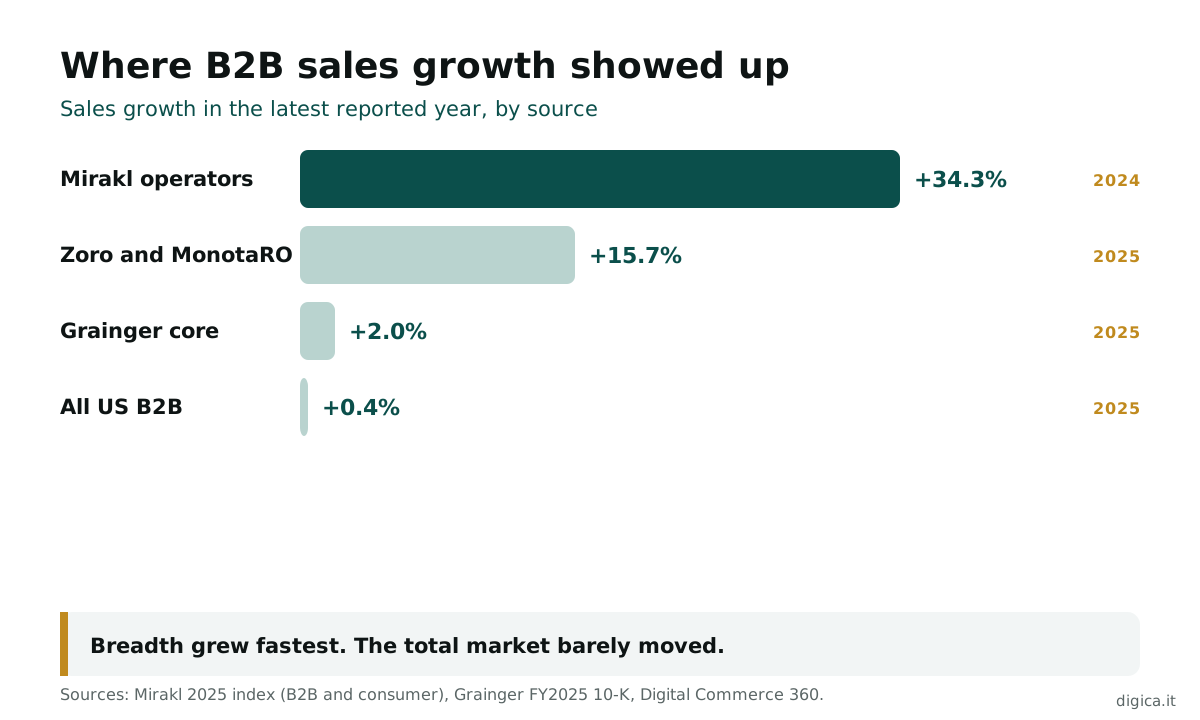
A European example is Conrad Electronic, which launched a B2B marketplace on Mirakl in 2017 and, according to Mirakl's case study, grew from about 800,000 own products to more than 7 million offers. Mirakl's own 2025 index found that 153 marketplaces on its platform grew sales 34.3% in 2024, though that figure mixes B2B and consumer operators.
The cost is not only software. Platform choices are covered in our ranking of B2B ecommerce marketplace platforms, and one integrator's 2026 estimate put a Mirakl-based B2B marketplace at about $66,000 to $165,000 to implement plus $110,000 to $275,000 a year in licence fees, with launch in three to nine months. Mirakl does not publish prices, so treat that as a starting range. The bigger cost is the work after launch: recruiting sellers, keeping their data clean, and getting buyers to trust products you do not stock. That is a supply acquisition job, and it never finishes.
In our experience, the B2B marketplaces that work grow supply and demand from the same engine. A B2B agency marketplace we worked with has 40,000+ listed agencies and 1M+ monthly users, grown from five people. The lesson is the same for a distributor: sellers join where buyers already are, and buyers stay where the catalog is complete.
Route 3: selling through existing B2B marketplaces
The short answer: selling on Amazon Business, Alibaba.com or a vertical B2B marketplace gives you buyers on day one, at the cost of a fee on every sale and a customer relationship you do not own.
The reach is hard to match. Amazon Business says it reached $60 billion in annualized gross sales in the second quarter of 2026 and serves more than 11 million organizations in 11 countries. On Amazon's standard US fee schedule, the referral fee for business, industrial and scientific supplies is 12% of each sale, with a $0.30 minimum, plus $39.99 a month for a professional seller plan. Export platforms charge differently: Alibaba.com's US supplier packages, as listed in our ranking of B2B directories, run from $2,799 to $8,299 a year.
Vertical B2B marketplaces sit between the two. Digital Commerce 360 counted about 500 industry-specific B2B marketplaces in the US in 2024, up from 75 five years earlier. For a specialist manufacturer, the right vertical B2B marketplace can reach more qualified buyers than Amazon Business, because every visitor is already in the category. Our rankings of wholesale marketplaces and procurement marketplaces compare the main options.
The risk is dependence. Fees rise, rules change, and the marketplace sees your customers' buying data. A manufacturer that sells only through others is renting its customer base. Use existing B2B marketplaces to reach buyers you cannot reach alone, and to test demand for new products before committing your own channel.
The three routes side by side
The short answer: a webshop is cheapest per sale and slowest to reach new buyers, your own marketplace is the most expensive and the broadest, and selling on others is fastest to revenue and weakest on ownership.
Three B2B ecommerce routes compared on upfront cost, ongoing cost, time to first sale, control, reach, main risk and best fit
| Own webshop or portal | Own B2B marketplace | Sell on existing B2B marketplaces | |
|---|---|---|---|
| Upfront cost | Platform and integration, varies widely | About $66,000 to $165,000 to implement on Mirakl (one integrator's estimate) | Low: listing and catalog setup |
| Ongoing cost | Hosting, content, search | About $110,000 to $275,000 a year in licence (estimate), plus seller recruitment | Fees on each sale, such as Amazon's 12% referral fee, or annual packages |
| Time to first sale | Weeks for existing accounts | Three to nine months to launch | Days to weeks |
| Who owns the customer | You | You | The marketplace |
| Reach to new buyers | Low until found in search | Grows with the catalog | High from day one |
| Main risk | Nobody new finds it | Thin supply, lower margin | Dependence and rising fees |
| Best for | Manufacturers with loyal accounts | Distributors whose buyers want breadth | Testing demand and reaching new segments |
Read the table as a sequence, not a menu. Most distributors that run a successful marketplace started with a webshop that showed them what buyers searched for and could not find.
B2B ecommerce best practices that apply to every route
The short answer: whichever route you pick, show the buyer's own price, make reordering easy, keep product data complete, and be findable where buyers search, including AI answers.
- Show contract prices after login. A B2B buyer who sees a list price they never pay will leave or call.
- Make the tenth order easier than the first. Saved lists, quick reorder and purchase order checkout matter more than a polished homepage.
- Treat product data as the product. Complete specifications, units and certifications decide whether an engineer trusts the listing, on your site or anyone else's.
- Track the searches that return nothing. They are the clearest signal of what to add, and of whether a marketplace would pay.
- Be visible beyond your own site. Category pages that rank, earned editorial mentions and structured data decide whether buyers and AI assistants name you. We earn editorial placements on real company domains and point them at the pages that convert. No paid directories, no bought links.
Not sure which route your buyers would choose?
A growth audit maps how your buyers search for what you sell, on Google, on marketplaces and in AI answers, and shows which route reaches them first.
For B2B marketplace operators, these practices are the difference between a catalog and a business. One water and wastewater marketplace we worked with reached 10x+ organic impressions within six months. Our growth audit starts with the same check: what buyers search for, what they find, and the gap between the two, which is the evidence a marketplace business case needs before anyone signs a platform contract.
Three failure scenarios
These are the patterns we see when distributors and manufacturers pick a route without a plan for the one after it.
- The portal nobody new found. A regional industrial distributor builds a capable B2B portal for its 3,000 accounts. Reorders move online and the sales team is relieved. Two years later, new-customer revenue from the portal is close to zero, because no one outside the customer base can find it. Investing in category pages and search from the start would have made the portal a growth channel, not just a service tool.
- The marketplace with no sellers. A distributor launches its own B2B marketplace with a strong platform and a launch budget, but recruits sellers as an afterthought. Buyers search, find gaps and leave, and sellers will not join a marketplace with no buyers. Recruiting the first sellers in the two or three categories buyers searched most, before launch, would have given it a reason to exist.
- The channel that became the business. A manufacturer grows fast on a large B2B marketplace and lets its own site lapse. When the marketplace changes its fees and search ranking, sales fall and the manufacturer has no direct channel to fall back on. Keeping its own webshop live, and moving repeat buyers to it, would have protected the margin.
Each company picked a reasonable route. None planned for the one that should have followed.
Which route first: a decision framework
The short answer: start where your buyers already are and your catalog is strongest, then add the route that fixes the first one's weakness.
- If more than 70% of your revenue comes from accounts you already serve, start with a webshop or portal, and track every search that returns no result.
- If buyers search your webshop for products you do not stock in more than one search in five, plan your own B2B marketplace for those categories.
- If you can name at least 50 sellers who would fill those gaps, launch the marketplace; if you cannot, sell their products through partnerships first.
- If you need new buyers in a segment where you have no sales team, sell through an existing B2B marketplace and measure margin after fees.
- If more than 40% of your online revenue comes from one marketplace, invest in your own channel before the next fee change.
- If you are a specialist manufacturer, a vertical B2B marketplace in your category usually beats a general one, because every visitor is already a buyer.
Planning or running a B2B marketplace?
We help B2B marketplaces acquire supply, generate demand and build revenue engines that compound, from the first sellers to qualified leads.
The number to take into your next strategy meeting is the share of buyer searches your catalog cannot answer. If it is below one in ten, a webshop and better search will do more than a marketplace. If it is above one in five, every month without a broader catalog is revenue going to a competitor that has one. Our view after publishing 40 B2B marketplace and directory rankings since October 2026: the platforms that lead a category tend to be the ones with the most complete supply, not the best software. That is the decision this playbook is really about: leads and organic growth from the same engine, pointed at the catalog your buyers want.
Put a currency figure on the alternative too. A manufacturer selling $5 million a year through Amazon Business at the standard 12% referral fee pays about $600,000 a year in fees, every year, for access to buyers Amazon says number more than 11 million organizations (Amazon). Moving even a quarter of repeat buyers to your own channel keeps about $150,000 of that. The biggest cost of doing nothing is a customer base you rent rather than own, priced by someone else's fee schedule.
FAQ
What is a B2B ecommerce strategy? A B2B ecommerce strategy is a plan for how a business sells to other businesses online: which channels it uses, such as its own webshop, its own B2B marketplace or existing marketplaces, who owns the customer relationship, and how the catalog, pricing and payment terms work online.
What is the difference between B2B and B2C ecommerce? B2B ecommerce serves business buyers who order in larger quantities, on negotiated prices and payment terms, often with approvals and repeat orders. B2C ecommerce serves individual consumers with list prices and card checkout, and is built around the first purchase rather than the reorder.
What are the main benefits of B2B ecommerce? Lower cost to serve routine orders, reach to buyers who never met your sales team, and data on what buyers search for and cannot find. Gartner found 61% of B2B buyers prefer to buy without a sales rep, and McKinsey found ecommerce is the largest sales channel for B2B companies that offer it.
What are B2B ecommerce best practices? Show each buyer's contract price, make reordering fast, keep product data complete, track searches that return no results, and be visible in search and AI answers, not only on your own site.
Should a distributor launch its own B2B marketplace? When buyers regularly search for products the distributor does not stock and it can recruit sellers to fill those gaps. Grainger's endless assortment businesses grew 15.7% in 2025 by adding third-party products, but at a lower margin than its core business.
How much does it cost to sell on Amazon Business? On Amazon's standard US fee schedule, the referral fee for business, industrial and scientific supplies is 12% per sale, with a $0.30 minimum, plus $39.99 a month for a professional seller plan.
Related Articles
- B2B marketplaces and directories
- B2B marketplace growth strategy: what works in 2026
- Best B2B ecommerce marketplace platforms in 2026
- Best wholesale marketplaces for retailers in 2026
- B2B ecommerce trends 2026 for marketplace operators
- How to grow a B2B marketplace: a stage-by-stage guide
- Marketplace business models: how B2B platforms make money
- How to attract vendors to a B2B marketplace
Where this connects
This article is part of our B2B marketplace growth series. Browse more on the Digica blog.