The best insurance directories for businesses, ranked on carrier coverage
An insurance directory can show you who exists. It cannot tell you who will write your risk at a fair price. That gap decides whether a business buys good cover or spends a month chasing quotes it was never going to get. The largest directory here covers more than 16,000 insurers, and the smallest panel has just 18 carriers, yet the small panel may be the better starting point for a five-person firm.
The market behind these lists is large. US property and casualty direct premiums written reached $1.1 trillion in 2025, up 4.6 percent, with personal lines making up roughly half (NAIC). The other half is what this guide is about: the cover that businesses buy, and the directories that help them, and their brokers, find it.
This guide ranks seven insurance directories and business insurance platforms on one lens: carrier coverage, meaning how many insurers, markets or agents each one reaches, and what that count is worth in practice. It covers commercial insurance only. It is written for owners, finance leads and risk managers buying cover, for agents and brokers looking for markets, and for founders growing a commercial insurance B2B marketplace. Figures are each organization's own, checked on November 6, 2026.
Quick Navigation
- How we ranked carrier coverage
- The ranking at a glance
- 1. AM Best: the widest view of insurers
- 2. Trusted Choice: the widest view of agents
- 3. MyNewMarkets: the market finder for professionals
- 4. Lloyd's Market Directory: the route to specialty risks
- 5. WSIA: the wholesale route
- 6. Insureon: the widest small business panel
- 7. Simply Business: the short panel
- What an insurance directory cannot tell you
- Three failure scenarios
- Choosing an insurance directory: a decision framework
- What the right route to market is worth
- FAQ
- Related Articles
How we ranked carrier coverage
We ranked on how much of the commercial insurance market each directory lets you see, then on how useful that view is for a business decision. Size came first, but it did not decide everything, because the units differ on every line.
Search results for "insurance directory" are a mixed bag. They include paid annual reference books, regulator license lookups, vendors selling insurer contact lists and old trade press rankings. Few of them help a business or a broker choose where to start, so we kept this list to seven that are current and aimed at commercial use, or usable for it.
We asked three questions of each: what does the number count, who is the directory for, and what does it check? We read each figure on the organization's own site or filing, and none is audited. We left out consumer comparison sites, since Digica works only with B2B marketplaces and directories. Two of the seven, Trusted Choice and MyNewMarkets, also cover personal lines, and we say so where it matters.
Our view: in insurance, a long list is a weaker signal than it looks. What counts is appetite, which is whether a carrier wants this type of risk this year. No count of insurers will tell you that.
The ranking at a glance
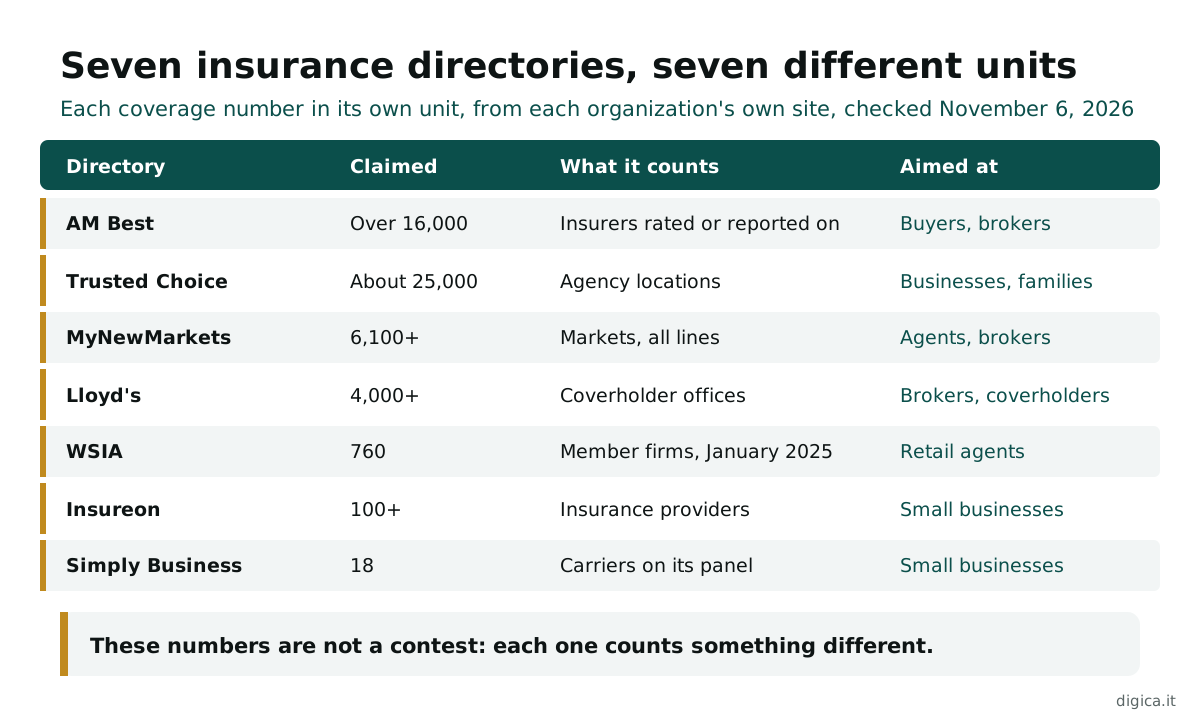
AM Best sees the most insurers, Trusted Choice reaches the most agency locations and MyNewMarkets is the most useful finder of markets for professionals. Only Insureon and Simply Business are built to take a small business through to a policy.
Seven insurance directories and platforms compared on what they cover, stated checks, who pays, main limit and best fit
| Rank and directory | Type | Coverage claimed | Stated checks | Who pays | Main limit | Best for |
|---|---|---|---|---|---|---|
| 1. AM Best | Ratings and reports | Over 16,000 insurance companies | Creditworthiness opinions | Reports are licensed | Does not quote or place cover | Checking an insurer |
| 2. Trusted Choice | Agent locator | About 25,000 agency locations | Big "I" membership | Free to search | Commercial fit varies by agency | Finding a local agent |
| 3. MyNewMarkets | Market finder | 6,100+ markets, 1,000+ providers | None described | No join cost, premium listings | Includes personal lines, for professionals | Agents hunting a market |
| 4. Lloyd's Market Directory | Participant list | 350+ brokers, 4,000+ coverholder offices | None described on the page | Public page | A list, not a quote tool | Specialty and unusual risks |
| 5. WSIA | Association members | 760 member firms | Membership criteria | Members fund it | No direct buying for businesses | Hard-to-place risks |
| 6. Insureon | Digital agency | 100+ insurance providers | Licensed producers | Compensation disclosure on site | Quotes only from its own panel | Small business quotes |
| 7. Simply Business | Digital agency | 18 carriers | Licensed agents | Not stated | Shortest panel here | Very small firms |
Do not read the coverage column as a contest. An insurer rated, an agency location and a market listing are three different things, so 16,000 does not beat 25,000 or 6,100.
1. AM Best: the widest view of insurers
AM Best is the broadest reference on insurers themselves. It says it assesses the creditworthiness of, or reports on, over 16,000 insurance companies worldwide, and does business in over 100 countries. Founded in 1899, it describes itself as a rating, news and data analytics firm focused on insurance.
It ranks first because of what it answers: can this insurer pay a claim years from now? For long-tail cover such as liability, that question matters more than the price. Brokers and procurement teams use its ratings as a pass or fail filter, and some contracts specify a minimum rating. Its Best's Insurance Reports are a licensed database, with terms that restrict redistribution.
The limit is plain. AM Best does not quote or place cover, and a strong rating does not mean the insurer wants your risk. Use it to check names you have already found, not to find them.
2. Trusted Choice: the widest view of agents
Trusted Choice is the largest way to reach independent agents, rather than insurers. It is run by the Independent Insurance Agents and Brokers of America, known as the Big "I", which represents about 25,000 agency locations. A new locator launched in June 2026, and member agencies are automatically searchable on it.
The agent route is the one that matters most for business cover, because independent agencies write most commercial premium in the US. A directory of agents is therefore often the shortest route to the carriers themselves, even though it lists no carriers at all.
Running a commercial insurance B2B marketplace or directory?
In 30 minutes we look at how businesses and brokers find platforms like yours, on Google and in AI answers, and where they leave before they request a quote.
It is free to search, and the Big "I" says the locator is a member benefit, not a paid subscription service. It speaks to businesses and families alike, however, and the count is of locations rather than commercial specialists. Ask each agency how much of its book is commercial, and whether it has written your class of business before. A local agent who mostly sells home and auto may not be the right call for a manufacturer.
3. MyNewMarkets: the market finder for professionals
MyNewMarkets is the most practical directory here if you are an agent or broker with a risk to place. Its searchable database holds more than 6,100 active commercial and personal lines markets from more than 1,000 providers, and it reports an average of 34,500 unique visitors a month.
The audience matters. If agents place most commercial cover, the tool they use to find markets shapes what a business gets offered, even when the business never sees that tool.
The value shows at category level. Its cyber liability search, for example, lists 2,725 entries from 28 companies, which also shows how to read the headline number. One provider can hold many listings, so the count of companies is the figure that tells you how many doors there are to knock on.
Agents can join at no cost, and listed companies can pay for premium placement, which includes boosted positions. So a higher position in the results may reflect a paid listing rather than a stronger appetite. We saw no vetting of listings described on the site. It is a place to build a call list, and most business owners will want a broker to use it for them.
4. Lloyd's Market Directory: the route to specialty risks
Lloyd's Market Directory is the list to use when the risk is large or unusual. It lets you search participants in the Lloyd's market by name, class and sub-class of business, domicile and authorized territory, with company types that include brokers, coverholders, managing agents, members' agents and open market correspondents.
The market it maps is global. Lloyd's says more than 350 registered brokers and a network of over 4,000 coverholder office locations work in the market, serving people and businesses in over 200 countries and territories.
The directory itself gives no count of entries, and it does not quote. Its use is narrower than the others here, and very valuable when you need it: finding who can actually bring a specialty risk to that market in your territory. Most mid-size firms will reach it through their own broker, and they should ask that broker which route was used.
5. WSIA: the wholesale route
The Wholesale and Specialty Insurance Association is where agents go when a standard market says no. It counted 760 member firms at January 1, 2025: 278 US wholesale firms, 176 US insurance market firms, 78 associates and 230 service members, with 1,566 offices in all. Its About page now rounds this to approximately 750.
That segment is growing quickly. WSIA's chief executive said in September 2026 that surplus lines premium reached $143.3 billion in 2025, up 10.4 percent. When standard carriers pull back from a class of risk, this is where it tends to go.
The limit for a business owner is access. Surplus lines cover is normally placed through a retail agent working with a wholesaler, so a business cannot usually buy direct. The practical step is to ask your agent which wholesalers they use for your class, and to check those names against the member list.
6. Insureon: the widest small business panel
Insureon has the longest panel of the two digital agencies here. It says it is licensed in every state and has access to 100+ top-rated insurance providers, and that it has delivered over 1.8 million policies to more than 450,000 small businesses, with more than $3 billion in premiums written. Those are its own figures, and an older page on its site shows lower ones.
It is not a neutral directory. It is an agency, now part of HUB International, and its licensed producers match applications to carriers on its panel. That is a strength for a small business owner who wants quotes for general liability or professional cover in a single sitting, without calling three agents.
Read the panel count with care. A hundred providers does not mean a hundred quotes on your risk, because each one has its own appetite by industry, state and size. Larger or more complex firms usually need a broker who can go beyond one panel. Agents remain the main route: independent agencies wrote 87.7 percent of commercial lines written premiums in 2025, compared with 87.9 percent in 2024 (Big "I"). That figure comes from the association behind Trusted Choice, so read it with that in mind, although it uses AM Best premium data. Our guide to the best fintech directories covers the adjacent financial services category.
7. Simply Business: the short panel
Simply Business has the shortest panel in this ranking, and that is why it is useful as a benchmark. It states 18 top-rated carriers, more than 1 million customers worldwide and more than 400 business types covered. It was founded in the UK in 2005, launched in the US in 2017, and was bought by Travelers that same year.
For a very small firm, 18 carriers can be enough, as the risks are simple and most of the work is finding one suitable policy quickly. Licensed agents support the process, and the site matches cover by business type, risks and budget.
It ranks last on coverage, not on quality. If your business sits outside mainstream classes, or your premium is large enough to justify advice, a short panel gives you fewer options to compare, and you may never know what you did not see. Compare one quote here with one from a broker before renewing for a second year.
What an insurance directory cannot tell you
A directory shows who exists and, sometimes, who is financially sound. It does not show appetite, price or how a carrier behaves when a claim arrives, and those three things decide most business insurance outcomes.
Appetite moves. A carrier that wrote your class last year may have pulled back this year, and one that declined it may now want it. The growth of surplus lines shows how quickly risks shift between markets when standard carriers change their minds. Directories rarely update fast enough to show you that shift, and most listings say nothing at all about what a carrier is hungry for right now.
Before you trust a listing, ask three questions. When did this carrier last write a risk like mine? What is its current financial strength rating? And is the agent or broker licensed in my state, which you can check with the state regulator? A directory can start this work, but it will not finish it. Our guide to construction directories makes the same point in a different category: a listing is a starting point rather than a check.
Three failure scenarios
These patterns recur when a business treats a list of names as a placement, and they tend to surface only at a claim or a renewal. The dollar figures are illustrative.
- The agent who had never written the class. A small manufacturer picks the nearest agency from a locator, and the agent places it with a carrier that excludes a core product line. The gap surfaces at claim time, on a $90,000 loss. Asking how many similar accounts the agent writes would have taken one phone call.
- The cheapest quote from an unchecked insurer. A procurement lead picks the lowest premium on a long-tail liability program without checking the rating, and a key customer's contract requires a minimum rating. The contract is held up until the cover is replaced, and the mid-term change costs about $12,000. Checking the rating against the contract first would have taken minutes.
- The short panel that stayed for years. A growing firm buys online when it has five staff and simply renews as it reaches 60. Nobody has reviewed the program, so its premium and its cover no longer fit the business. Going to a broker at the renewal, once payroll passed a set level, might have saved $15,000 a year.
Do businesses and brokers find your platform first?
A growth audit maps how commercial insurance buyers and agents search for cover and markets, on Google and in AI answers, and which class, state and carrier pages you are missing.
In each case, the directory did its job. It produced real names, and every name was licensed or listed. The mistake was treating a found name as a suitable one, then leaving the decision alone for years. A short check at the start, and a set trigger for reviewing the program later, would have changed all three outcomes at very little cost.
Choosing an insurance directory: a decision framework
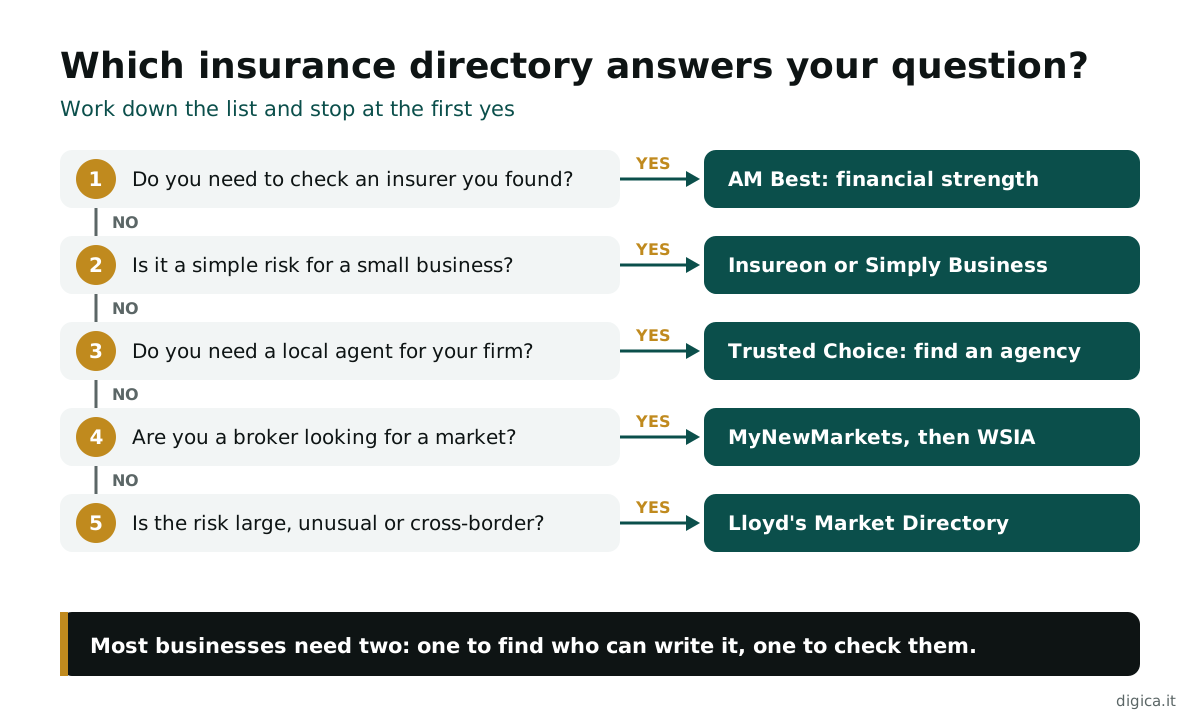
Start from your question, then the size of the premium. Most businesses need two of these: one to find who can write the risk, and one to check them.
- If you are checking an insurer already quoted, use AM Best, and compare its rating with any minimum in your contracts.
- If your annual premium is under about $10,000 and your risks are simple, get quotes from Insureon or Simply Business, and keep one comparison from an agent.
- If your premium is above about $25,000, or you have staff in more than one state, use Trusted Choice to find an independent agent, and ask how much of the book is commercial.
- If you are an agent with a risk to place, start with MyNewMarkets, then count companies rather than listings.
- If two standard carriers have declined, ask your agent about a wholesaler, and check the WSIA member list.
- If the risk is large, unusual or crosses borders, use the Lloyd's Market Directory with your broker to see who can reach that market.
The thresholds are starting points. Our guides to B2B directories and supplier databases cover how to evaluate listings in other categories, and our guide to lending marketplaces covers another financial product where who pays the platform changes what you see.
What the right route to market is worth
The right route to market is worth a better fit on cover and, usually, a lower premium for the same risk. A directory costs little, while an unsuitable placement can cost many times the premium.
Run an illustrative case. A firm pays $60,000 a year across its commercial policies. If a broker with wider market access finds comparable cover at 15 percent less, that saves $9,000 a year, or $27,000 over three years, before any change in claims. The inputs are illustrative, so test them against a real quote. If one uninsured loss of $90,000 is avoided as well, the review pays for itself many times over.
The timing favors a review. Global non-life premium growth is forecast to hit a cyclical low of 0.6 percent in real terms in 2026, against a long-term trend of 3.6 percent, partly on competitive pricing (Swiss Re Institute). When pricing is competitive, carriers can compete harder for good risks, so a business that does not shop around may be overpaying.
Growing a commercial insurance B2B marketplace?
We help commercial insurance B2B marketplaces and directories win the agents and carriers that make them credible, and reach the businesses searching for cover.
The number to take into your next finance review is how many carriers actually saw your risk at the last renewal. If the answer is one, you do not know whether your price is fair. Ask your agent for that number before the next renewal, in writing, along with each carrier's rating. The biggest cost of doing nothing is renewing the same program for years because a list once gave you a name.
FAQ
What is an insurance directory? An insurance directory is a searchable list of insurers, agents, brokers or insurance markets. Some rate insurers, such as AM Best. Others help you find agents, such as Trusted Choice, or help professionals find markets, such as MyNewMarkets.
How do I find a commercial insurance broker for my business? Use a locator such as Trusted Choice, which covers about 25,000 independent agency locations through the Big "I", then ask each agency how much commercial business it writes, and whether it has placed your class before.
How do I check whether an insurer is financially sound? Look up its financial strength rating. AM Best assesses or reports on over 16,000 insurance companies worldwide. Compare the rating with any minimum set by your contracts or lenders.
What is the difference between an insurance agent, a broker and a wholesaler? An agent or a broker works with you to place cover. A wholesaler works with agents and brokers to place risks that standard carriers will not take, usually in the surplus lines market. Most businesses reach a wholesaler through their own agent.
Where can I find a list of insurance companies for business cover? AM Best is the broadest reference on insurers. For finding who writes a particular class, MyNewMarkets lists more than 6,100 active markets from more than 1,000 providers, although agents and brokers are its main users.
Are online business insurance platforms independent? Not fully. Insureon and Simply Business are agencies that quote from their own panels, of 100+ providers and 18 carriers. They are useful and quick, but they show only those panels, so compare at least one outside quote.
Related Articles
- Commercial insurance marketplace growth
- Best fintech directories and communities in 2026
- Best lending marketplaces for business loans
- Best B2B directories
- Best legal directories
Where this connects
This article is part of our B2B marketplace growth series. Browse more on the Digica blog.