Agentic commerce in B2B: a marketplace readiness guide
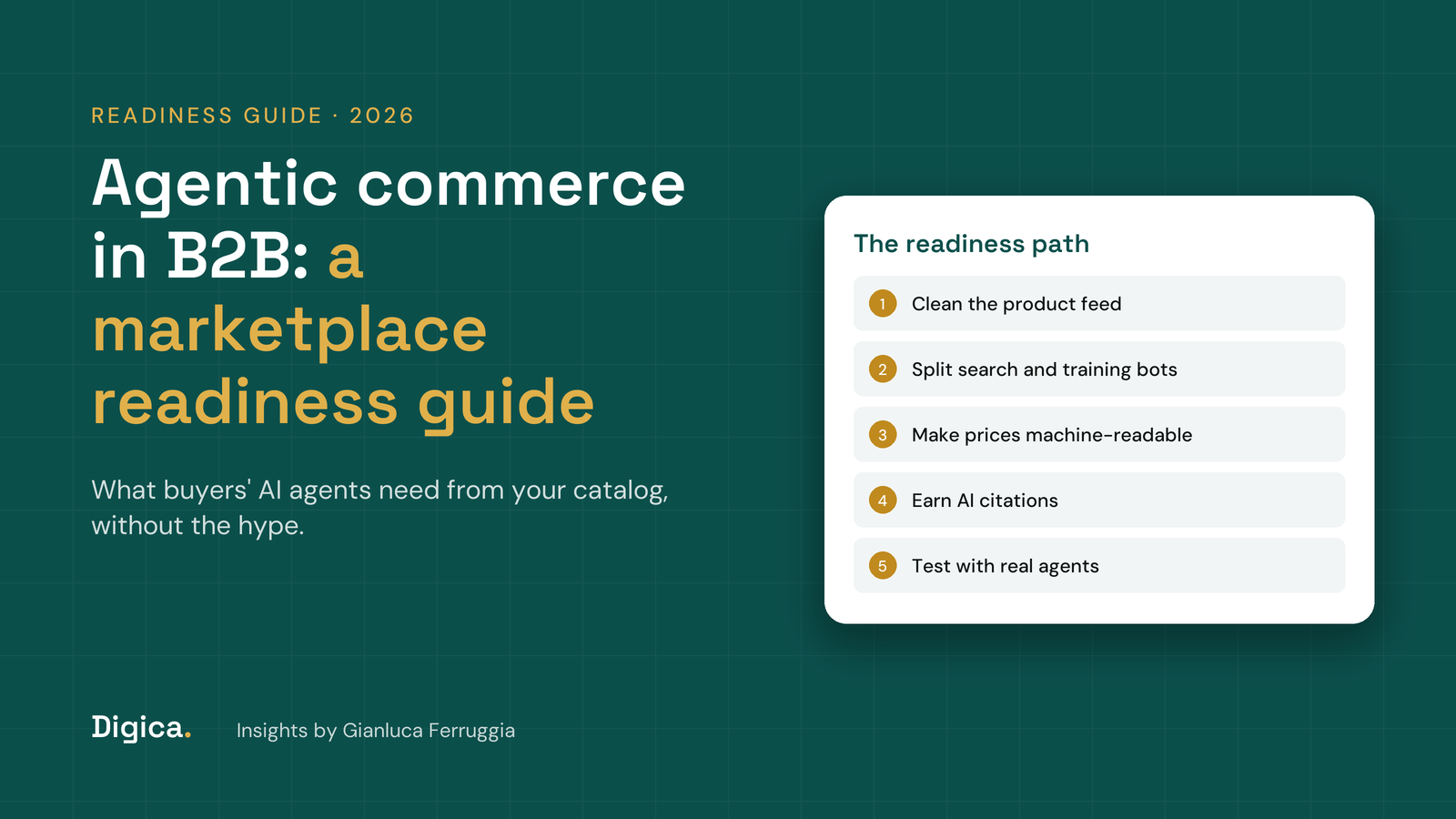
Agentic commerce is buying and selling in which AI agents research, compare and sometimes complete purchases on behalf of a person or a business. For a B2B marketplace, the question is not whether this arrives in one dramatic year. It is whether an agent that reads your catalog can understand what you sell, who sells it and on what terms. Most B2B catalogs today would fail that test in quiet, expensive ways.
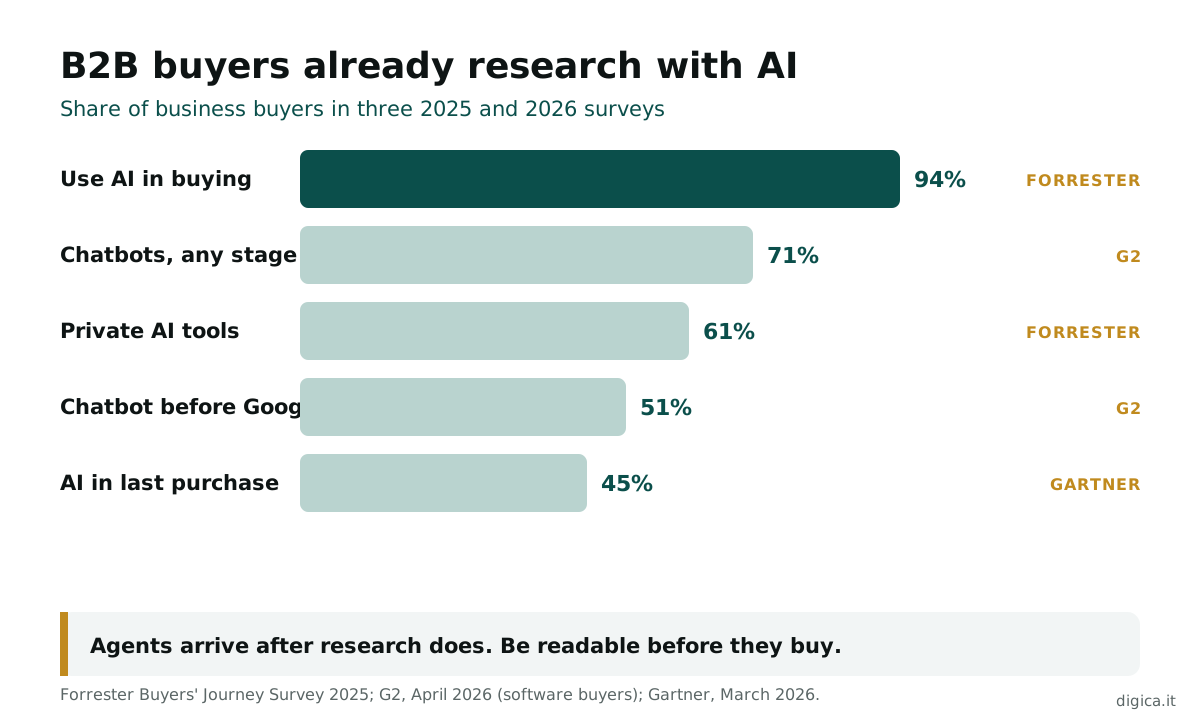
The buyer side has already moved. In 2025, 61 percent of B2B purchase influencers said their organization has or will use a private generative AI engine to support purchasing, and Forrester expects one in five B2B sellers to face quote negotiations led by buyers' agents in 2026 (Forrester). The seller side, and most B2B marketplaces, have not.
This guide explains what agentic commerce changes for B2B marketplace operators, which protocols matter, and the four readiness areas we would fix first: a catalog machines can read, access for the right agents, prices and quotes in a form an agent can use, and being the source AI answers cite. It is written for founders and growth leads of B2B marketplaces and directories. It treats agents as a distribution channel with mechanics, not as a revolution.
Quick Navigation
- What agentic commerce means for a B2B marketplace
- The protocols, and what each asks of a marketplace
- AI in B2B ecommerce today: research and negotiation, not checkout
- Readiness area 1: a catalog machines can read
- Readiness area 2: let the right agents in
- Readiness area 3: prices, quotes and contract terms
- Readiness area 4: be the source AI answers cite
- Agent-ready and not ready, side by side
- Three failure scenarios
- Where to start: a decision framework
- What agent readiness is worth
- FAQ
- Related Articles
What agentic commerce means for a B2B marketplace
For a B2B marketplace, agentic commerce means a new kind of visitor: software acting for a buyer, reading your listings, comparing them with others and reporting back, or placing an order within limits a person has set. It does not browse your homepage. It reads your data.
The best-known forecasts are about consumers. McKinsey's October 2025 estimate of up to $1 trillion in orchestrated US retail revenue by 2030, and $3 trillion to $5 trillion globally, covers goods sold to consumers, and the report says it does not account for the B2B marketplace. Gartner is the main analyst to put a number on business buying. It predicts that by 2028, 90 percent of B2B buying will be AI agent intermediated, pushing over $15 trillion of B2B spend through AI agent exchanges.
Read that word carefully. Intermediated does not mean bought by a robot. It means an agent sits somewhere in the path: shortlisting suppliers, summarizing listings, drafting a quote request or checking a price. That is a far nearer prospect than autonomous purchasing, and it is the one a marketplace should prepare for.
Our view: the risk for a B2B marketplace is not that agents replace it. The risk is that an agent assembles the shortlist from a competitor's cleaner data, or straight from suppliers' own sites, and your marketplace never appears in the answer.
The protocols, and what each asks of a marketplace
Four open protocols now shape how agents find products, talk to merchants and pay. None of them was designed for B2B first, and each asks something different of a marketplace.
The Model Context Protocol (MCP), which Anthropic released in November 2024, is how agents connect to tools and data. By December 2025, when it moved to the Linux Foundation's new Agentic AI Foundation, there were more than 10,000 published MCP servers. For a marketplace, an MCP server is a way to let an agent search your catalog directly, rather than scrape it.
The Agentic Commerce Protocol (ACP), developed by OpenAI and Stripe and launched in September 2025, covers product feeds and checkout. Its April 2026 release changed order quantities from whole numbers to decimals, explicitly to support B2B commerce, such as items sold by weight. It also added a discovery file and a feed interface through which merchants push catalog data to agents.
Is your B2B marketplace ready for buyers' AI agents?
In 30 minutes we look at how AI answers describe your category today, which listings an agent can read, and where your marketplace drops out of the shortlist.
Google's Agent Payments Protocol (AP2), announced in September 2025, records what a buyer authorized an agent to do, through signed instructions that set limits on price and timing. Google's announcement names B2B uses, such as autonomous procurement through its cloud marketplace. Its Universal Commerce Protocol (UCP), introduced in January 2026, lets businesses publish their supported services in a standard file at a fixed address, and on Google it requires an active Merchant Center account.
The B2B gaps are visible in the open. In autumn 2026, UCP's public issue tracker carried proposals for catalog items with no public price, for quotes and for a B2B procurement group covering requisitions, approvals and purchase orders. That is the part of B2B buying the protocols do not yet express.
AI in B2B ecommerce today: research and negotiation, not checkout
AI in B2B ecommerce today is mostly about research and negotiation. Agents shortlist, summarize and draft. People still approve the order, and that will hold for any purchase that needs a budget code.
The research shift is large. Forrester's 2025 buyers' journey survey found that 94 percent of business buyers use AI in buying, and twice as many named generative AI or conversational search as their most meaningful source of information, ahead of vendor websites and sales. G2 reported in April 2026 that 51 percent of B2B software buyers now start research in an AI chatbot more often than in Google, up from 29 percent a year earlier.
Negotiation is next. Alibaba's Accio sourcing agent, used by more than 10 million people a month by March 2026 on Alibaba's own count, now runs supplier negotiations, but Alibaba says it cannot close deals on its own: users approve pricing, terms and purchase orders. Amazon Business announced in October 2026 that it is bringing agentic procurement into e-procurement systems, exchanging purchasing policies, budgets and order history with them.
Trust is the limit. Forrester found that 19 percent of buyers using these tools felt less confident in their decisions because of inaccurate information from generative AI. That is the opening for a B2B marketplace: an agent that has to be right needs a source it can trust, with verified sellers and current data.
Readiness area 1: a catalog machines can read
A catalog machines can read has stable identifiers, a price or a clear statement that pricing is on request, availability, and a clear line between the marketplace and the seller. Most B2B catalogs fail on the last two.
The agent feeds now being built show what is expected. OpenAI's product feed specification requires nine fields on every row, including availability and price, and rejects a row whose availability is missing or unrecognized (OpenAI). It recommends uploading a full snapshot at least once a day. It also tells implementers not to invent a manufacturer part number to replace a missing barcode.
One detail matters more to marketplaces than to anyone else. The same specification has a field for the seller and a separate field for the marketplace where checkout happens, required for third-party offers. An agent, in other words, is expected to know that a listing on your platform is sold by someone else. If your catalog blurs that, the agent either drops the offer or attributes it wrongly.
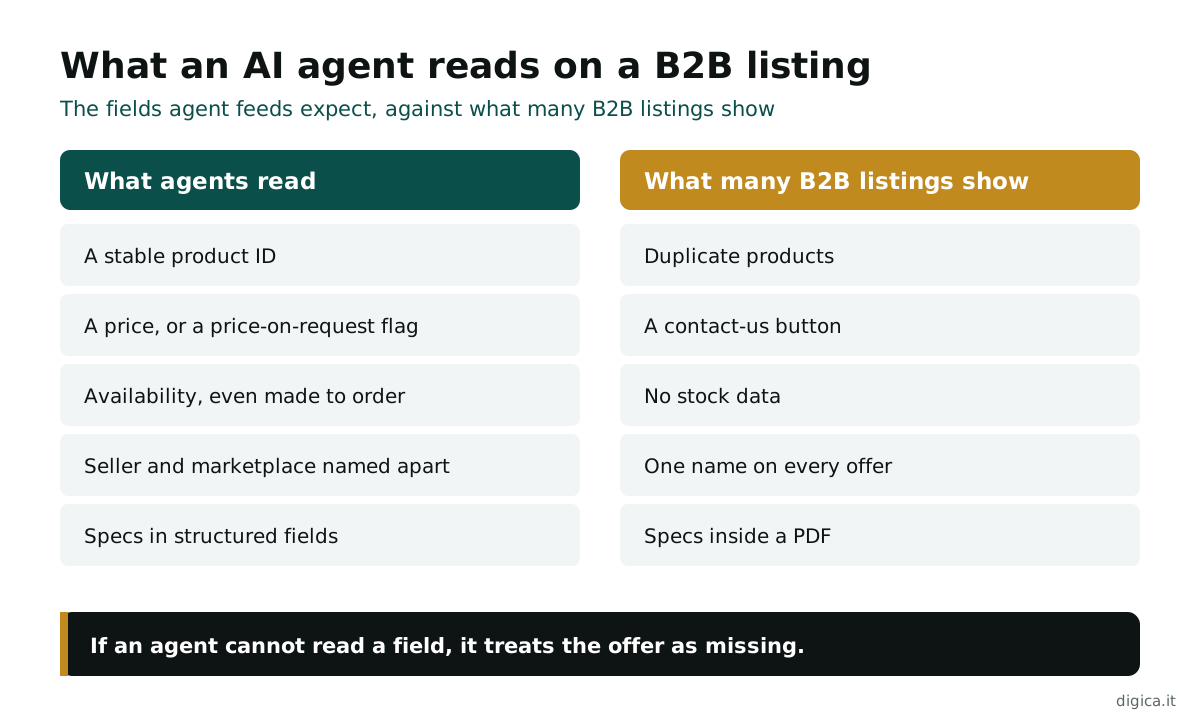
The fix starts with the boring parts. Give every product and every seller a stable ID. Move key specifications out of PDFs and into fields. Mark availability, even if it is only "made to order". And mark products with no public price as price on request, rather than hiding the field, because agents treat an empty field differently from a stated policy.
Readiness area 2: let the right agents in
Letting the right agents in means separating the crawlers that put you in AI answers from the crawlers that train models, and making sure your bot defenses do not block legitimate agents. These are separate decisions, and many B2B marketplaces make them as one.
The vendors document the split. OpenAI's OAI-SearchBot surfaces sites in ChatGPT's search answers, while GPTBot collects content that may be used for training. Blocking the second does not remove you from the first. Perplexity says its PerplexityBot surfaces sites in its answers and is not used to train foundation models. Google-Extended controls whether Google may use your content for Gemini training and grounding. Several user-triggered fetchers, which act for a person in real time, say they may not follow robots.txt at all.
Bot defenses are the second trap. When Visa launched its Trusted Agent Protocol in October 2025, it named merchant bot detection that mistakenly blocks legitimate agent transactions as a problem to solve. A B2B marketplace with aggressive firewall rules may be invisible to the agents its own buyers use, with no error in any report.
Our view: decide training and visibility separately, write it down, and test it. Our position on training crawlers is set out in our note on AI training opt-outs, and our AI crawler readiness work covers the firewall side.
Readiness area 3: prices, quotes and contract terms
Prices are where B2B differs most from consumer shopping, and where agents struggle most today. A consumer cart has one price. A B2B buyer has a list price, a contract price, a volume tier and often a quote that only exists after a conversation.
The protocols are only starting to handle this. UCP's catalog currently expects a price on every item, and its open proposals from late 2026 cover items with no public price, quote requests and pricing that depends on who is asking. Until those settle, an agent that reaches a B2B listing with no price and no machine-readable route to a quote has little to work with.
How do AI answers describe your category today?
A growth audit checks what AI answers say about your B2B marketplace and its category, which listings and pages agents can read, and the fixes that would put you in the shortlist.
You do not need to publish contract prices to be readable. You need to state, in fields, how pricing works: list price where you have one, a price-on-request flag where you do not, minimum order quantities, volume tiers, and a structured quote request with the inputs a supplier needs. That is the same information a buyer's agent will try to extract from a sales rep.
There is a growth case here too. Forrester expects sellers to answer agent-led negotiations with their own agents. A B2B marketplace that gives its sellers structured quote handling becomes the place where that negotiation happens, rather than a directory that sends the buyer elsewhere to talk.
Readiness area 4: be the source AI answers cite
Being the source AI answers cite means the agent's summary of your category names your marketplace, links your pages and uses your data. This is the part of agentic commerce a B2B marketplace can influence today, before any checkout protocol supports its flows.
The mechanics are not exotic. Google says you do not need new machine-readable files or special schema to appear in its AI features, and that what helps is structured data that matches the visible page, plus an up-to-date Merchant Center and Business Profile. The same rules that make a category page rank make it citable: clear facts, current numbers and a page that answers the question a buyer asks.
Visibility in AI answers is one of the four jobs we do for B2B marketplaces, alongside traffic and authority, audience and supply, and revenue. In our own work, a water and wastewater marketplace reached 10x+ organic impressions within six months, and the same pages that win search are the ones AI answers quote. That is the promise behind our work: leads and organic growth from the same engine.
Our guides to getting cited by AI answer engines and GEO for marketplaces cover the method in more depth. The short version: an agent cites the page that is easiest to trust, so make your category pages the clearest statement of what your market offers.
Agent-ready and not ready, side by side
The difference between an agent-ready B2B marketplace and one that is not is mostly data discipline. The table sets out what each looks like in practice.
Agent-ready and not-ready B2B marketplaces compared on catalog, seller identity, pricing, crawler access, bot defenses and AI citations, with the cost of each gap and who owns the fix
| Area | Not ready | Agent-ready | Cost of the gap | Owner of the fix | Best first step |
|---|---|---|---|---|---|
| Catalog | Specs in PDFs, duplicate products | Stable IDs, specs in fields, daily feed | Offers dropped from agent shortlists | Product and data | Deduplicate the top 100 products |
| Seller identity | Marketplace and seller blurred | Seller and marketplace named separately | Wrong attribution or no listing | Product | Add a seller field to every offer |
| Pricing | "Contact us" with no structure | Price or price-on-request flag, tiers, quote fields | Agent skips to a supplier with a price | Commercial | State the pricing rule per category |
| Crawler access | One rule for all AI bots | Search bots allowed, training decided separately | Absent from AI answers | Engineering | Review robots.txt by user agent |
| Bot defenses | Firewall blocks unknown agents | Verified agents allowed, abuse still blocked | Silent loss of agent traffic | Engineering and security | Test with two real agent tools |
| AI citations | Thin category pages | Clear facts, current numbers, structured data | Competitors define your category | Growth and content | Check what AI answers say today |
None of these needs a new protocol. All of them make a marketplace more useful to human buyers as well, which is why they are the first place to spend.
Three failure scenarios
These are patterns that recur when B2B marketplaces treat agentic commerce as a future project. The dollar figures are illustrative.
- The marketplace that blocked every AI bot. A platform blocks all AI user agents to stop training on its listings. It also blocks the search crawlers that feed AI answers, and its category disappears from the summaries buyers now read first. Inbound requests from AI referrals fall to zero, and a competitor becomes the default answer. Splitting training from visibility would have taken one afternoon.
- The catalog an agent could not price. A B2B industrial marketplace hides every price behind a contact form, with no flag and no structured quote route. A buyer's agent shortlisting suppliers skips the platform's listings for suppliers that state a price or a clear quote process. On a platform taking 5 percent of $10 million in quoted orders a year, losing a fifth of those requests costs $100,000 in fees.
- The seller nobody could see. A marketplace's feed lists every offer under its own name. Agents treat it as a single retailer, misreport availability across sellers and drop offers they cannot attribute. Sellers see fewer leads and start listing directly with agent platforms. A seller field on every row would have kept them.
In each case the marketplace did nothing wrong by the standards of 2023. The rules changed underneath it, and the cost showed up as missing demand rather than an error.
Where to start: a decision framework
Start with what you can measure this month, then the data work, then the protocols. Most B2B marketplaces should not start with a checkout integration.
- If you do not know what AI answers say about your category, ask the main assistants the five questions your buyers ask, and record who they cite. Do this first.
- If your robots.txt treats all AI crawlers the same, separate search crawlers from training crawlers before anything else.
- If more than 20 percent of your top listings have no price and no price-on-request flag, fix pricing fields before building any feed.
- If your catalog has more than 10,000 products, build a daily feed with stable IDs and a seller field, and test it against a published agent feed specification.
- If more than half your volume comes through quotes, design a structured quote request now, because the protocols will follow that pattern.
- If buyers already ask for API access, an MCP server or a protocol discovery file is worth piloting on one category.
- If none of this applies yet, keep the category pages clear and current, and review again in six months.
The order matters. Visibility work pays back now through search and AI answers, whatever happens to agent checkout. Protocol work pays back only when buyers' agents in your category use that protocol.
What agent readiness is worth
Agent readiness is worth the share of demand that now starts in an AI answer, and that share is already large among business buyers. The return on the first steps comes from search and AI visibility well before any agent places an order.
Want your B2B marketplace cited in AI answers?
We help B2B marketplaces become the source AI answers and buyers' agents use: structured category pages, readable listings and the authority that gets them cited.
Run an illustrative case. Suppose your marketplace earns $2 million a year in fees, and a quarter of new buyers now start their research in an AI tool, in line with the buyer surveys above. If your marketplace is missing from those answers and loses half of that group to competitors that appear, that is $250,000 a year in fees at risk, growing as the share grows. If a data and content program costs $90,000, it pays back in under five months on those assumptions. The inputs are illustrative, so use your own.
The number to bring to your next board meeting is the share of your category's buyer questions in which AI answers name your marketplace. If you have not measured it, that is the first task. The biggest cost of doing nothing is a category defined by someone else's data, at the moment buyers stop clicking through to check.
FAQ
What is agentic commerce? Agentic commerce is buying and selling in which AI agents research, compare, negotiate or complete purchases on behalf of a person or a business, within limits that person sets. In B2B, agents today mostly shortlist and draft, while people approve orders.
How is agentic commerce different in B2B? B2B purchases involve contract prices, quotes, approvals and purchase orders that consumer checkout does not. The main protocols were built for consumer carts first, and B2B features such as price on request and quote handling were still being proposed in late 2026.
Which agentic commerce protocols matter for a B2B marketplace? The Model Context Protocol connects agents to your data, the Agentic Commerce Protocol covers feeds and checkout, and Google's AP2 and Universal Commerce Protocol cover payment mandates and merchant capabilities. Start with clean data, which all of them need.
Do I need an llms.txt file for AI agents? No. llms.txt is a 2024 community proposal, not a standard, and Google says no special AI text files are needed to appear in its AI features (Google Search Central). Structured data that matches the page and an accurate product feed matter more.
Should a B2B marketplace block AI crawlers? Decide training and visibility separately. Blocking training crawlers such as GPTBot does not remove you from ChatGPT search answers, which use OAI-SearchBot. Blocking every AI crawler usually removes you from the answers your buyers read.
Will AI agents replace B2B marketplaces? Agents need trusted, structured sources, and a B2B marketplace with verified sellers and current data is one. The risk is not replacement but omission: an agent that cannot read your catalog will build the shortlist without you.
Related Articles
- Generative engine optimization for marketplaces
- B2B marketplace growth strategy: what works in 2026
- How to get cited by AI answer engines
- GEO for marketplaces
- AI in procurement: what it means for B2B marketplaces
- The B2B buyer journey now runs through marketplaces
- B2B ecommerce trends 2026 for marketplace operators
Where this connects
This article is part of our B2B marketplace growth series. Browse more on the Digica blog.