The B2B buyer journey now runs through marketplaces, even when the sale does not
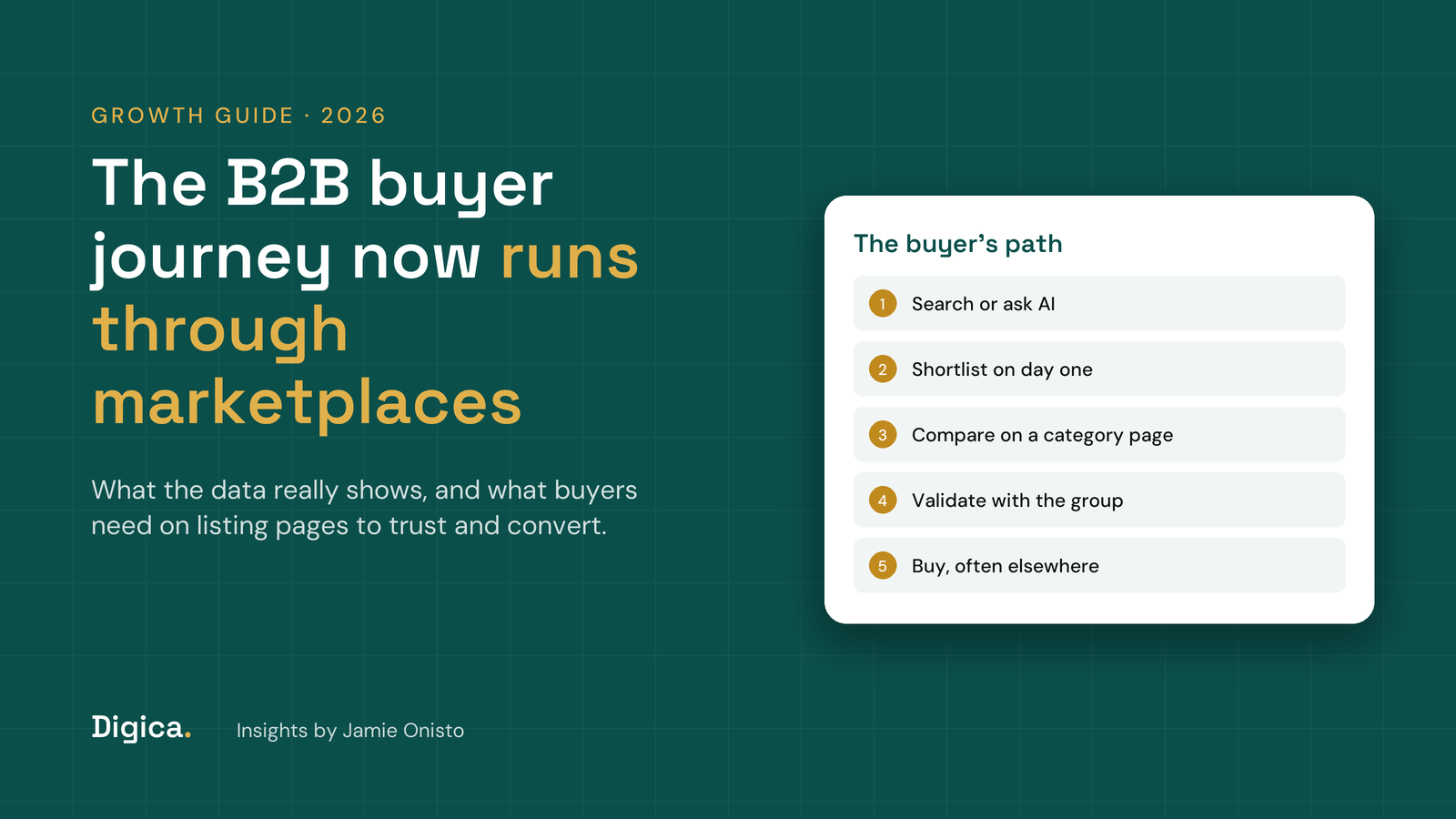
The B2B buyers journey is largely decided before a seller knows it has started. In 6sense's 2025 study of nearly 4,000 buyers, first contact came 61% of the way through the process, 94% had already ranked their shortlist, and 77% bought from the vendor they ranked first. So the pages a buyer reads on the way to that shortlist do much of the selling, and for a growing share of purchases those pages sit on a B2B marketplace.
You have probably seen a bolder claim: that most B2B buyers now purchase through marketplaces. We tried to trace it. We could not find a current, large-sample primary source that says so, and one of the most repeated figures turns out to be a misquote. The best sourced estimate we found puts B2B marketplaces at 1.3% of all B2B sales in 2023. The sale has not moved yet. The research has.
This guide is written for B2B marketplace operators and B2B marketers. It sets out what the data on adoption really shows, how B2B buyer behavior has changed, who a listing page has to convince and what buyers need on category and listing pages to trust and convert. It draws on our marketplace demand generation work. For the wider plan, see our B2B marketplace growth strategy.
Quick Navigation
- What the B2B buyers journey looks like in 2026
- How much B2B buying really happens on marketplaces
- Marketplace statistics to stop repeating
- Why the journey reaches marketplaces before the sale does
- Who your listing page has to convince
- Vendor sites and B2B marketplaces, side by side
- B2B buyer behavior on a category page
- What buyers need on a listing page
- Who B2B buyers actually trust
- Three failure scenarios
- Where to start: a decision framework
- What a page buyers trust is worth
- FAQ
- Related Articles
What the B2B buyers journey looks like in 2026
The B2B buyer journey is now mostly self-directed, shared by a large group and shaped by whatever the buyer finds first. Sellers join late and are often confirming a choice rather than creating one.
Gartner's survey of 645 B2B buyers, run in August and September 2025 and released in May 2026, found that 67% prefer a sales rep-free experience and 70% want a fully digital, self-service process. Buyers used an average of seven information sources on a recent purchase, and 45% used generative AI, mainly to gather information on vendors and products. That does not mean they trust it blindly: 69% prefer to validate AI-generated insights with a sales rep.
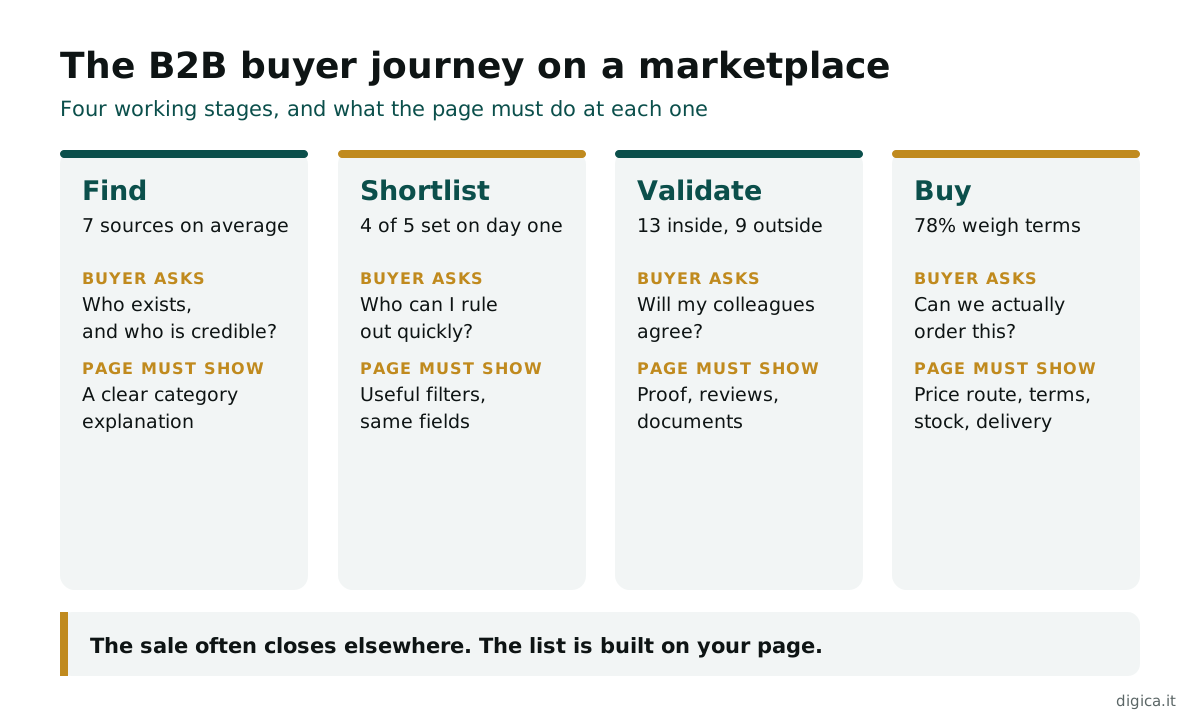
Then there is the shortlist. 6sense found that buying groups evaluated an average of five vendors and filled four of those five spots on day one of the process. The global buying cycle averaged 10.1 months in 2025, so most of that time goes on checking a list that was set early.
One caution on all of this. Much of the best research covers software and technology buyers. 6sense's sample is only about a quarter physical-goods buyers. A plant engineer ordering parts behaves differently from a team choosing a CRM, and we flag where that matters. The direction is the same across both groups, even if the numbers are not.
Our view: the job of a B2B marketplace page is to get a supplier onto a list that closes early. A page that only converts a ready buyer misses most of the journey.
How much B2B buying really happens on marketplaces
Far less than the headlines suggest, and growing quickly from a small base. The best public data shows marketplaces as a fast-rising channel, not yet the main one.
Digital Commerce 360 estimated that B2B marketplaces reached $224.0 billion in 2023, up from $113 billion in 2022, and that this was 1.3% of all B2B sales. The same article reports that 59% of B2B buyers conduct more than a quarter of their purchases on online marketplaces (Digital Commerce 360). That survey had just 103 respondents, so treat it as a signal of direction and not a measure of the market.
Those two numbers look contradictory, but they are not. A small group of buyers can use a marketplace often, and for small purchases, while the great majority of B2B dollars still move through contracts, sales teams and electronic data interchange. Hokodo's 2025 survey of 300 buyers in Europe and the UK found that 27% favor marketplaces, which fits the same picture: a real minority, and a meaningful one.
Scale at the top confirms the direction. Amazon Business reported more than $60 billion in annualized gross sales in 2026. Xometry reported 89,557 active buyers at June 30, 2026, up from 81,821 at the end of 2025. These are large and growing businesses, inside a B2B economy that is far larger still.
Marketplace statistics to stop repeating
Several of the most quoted figures on this topic do not hold up. If they are in your sales deck, take them out before a careful buyer checks them.
The most common is "83% of B2B buyers prefer marketplaces". Gartner's original finding was that 83% of B2B buyers prefer ordering or paying through digital commerce, which is a much wider channel. Somewhere along the way it was rewritten as marketplaces. Similarly, we could find no Forrester document behind the claim that 75% of B2B procurement spend will move to marketplaces within five years. It circulates on vendor blogs without a source. Forrester's separate prediction that agentic buying will touch 75% of B2B purchases by 2027 is about something else entirely.
Other figures are simply out of date. Forecasts saying that 75% of indirect purchasing would go through marketplaces by 2022 have passed, unmet, as far as any data we could find shows. And an estimate of marketplaces as a share of "B2B eCommerce" is not a share of B2B buying.
Are buyers finding your B2B marketplace early enough?
In 30 minutes we look at the pages buyers reach on the way to a shortlist, on Google and in AI answers, and what we would do first to get your suppliers onto it.
Why does this matter to an operator? Because credibility is the product. A marketplace pitching suppliers on an inflated figure will lose the procurement lead who checks it. The honest version of the story is strong enough: marketplace sales were growing quickly on the most recent public estimate, buyers increasingly research without talking to anyone, and the channel is still early enough to win. That version also survives a question from a supplier's finance team, which is the moment a borrowed statistic usually falls apart.
Why the journey reaches marketplaces before the sale does
Buyers use marketplaces for what they do best: showing many suppliers side by side, with structured data, at the moment a buyer is building a list. The final order may still happen elsewhere.
Think about what a buyer needs at the start. They want to know who exists, who is credible and roughly what it costs. A single vendor's site can answer only one of those, and it has an obvious interest in the answer. A category page on a B2B marketplace can answer all three at once. Thomasnet, for instance, says it lists over 500,000 North American suppliers. A buyer can start there with no idea who to call.
So a lot of marketplace value never shows up as marketplace sales. A buyer finds three suppliers on a directory, then emails them. Or they compare options on a review site, then buy on a contract through procurement. Your analytics record a referral at best, and often nothing at all. That is why measuring only on-platform transactions understates what a B2B marketplace does for a supplier, and why suppliers who only count closed orders often undervalue their listing.
Search and AI answers now reach these pages first. In G2's March 2026 survey of 1,076 software buyers, 51% said they start research with an AI chatbot more often than with Google, up from 29% a year earlier. Assistants tend to summarize from pages that compare options clearly, which is what a good category page does. Our guide to getting cited by AI answer engines covers that step.
Who your listing page has to convince
Not one buyer. A listing page has to work for a group of people who may never speak to you and who care about different things.
Forrester's 2025 Buyers' Journey Survey found that the average purchase involves 13 people inside the buying organization and nine external participants, and that 73% of purchases involve three or more departments (Forrester). Forrester also found that procurement professionals are decision-makers in 53% of business buying cycles. The person who found your page is rarely the only person who has to agree.
Consider who reads the same listing in a typical purchase:
- The user wants to know whether it does the job: specifications, compatibility, and whether people like them use it.
- Procurement wants price, payment terms, supplier status and whether it fits the buying system.
- Finance or the executive sponsor wants total cost and the risk of getting it wrong.
- Compliance or IT wants certificates, security and documents they can file.
Each of them is looking for a different row. A page written only for the user gets shared internally and then dies at procurement, for reasons the supplier never hears about. Our inference from this is practical: make the page easy to forward. Stable URLs, plain specifications and downloadable documents do more work inside a buying group than any headline.
Vendor sites and B2B marketplaces, side by side
A vendor site and a B2B marketplace do different jobs in the same journey. Buyers use the marketplace to narrow the field and the vendor site to confirm the choice.
Vendor sites and B2B marketplaces compared on the buyer's question, what each shows, trust signal, pricing, main risk, cost to the supplier and best use
| Aspect | Vendor website | B2B marketplace listing |
|---|---|---|
| Buyer's question | Can this supplier do what I need? | Who are my options, and how do they compare? |
| When it matters most | Late, while validating a choice | Early, while building a shortlist |
| Trust signal | Case studies and the brand's own claims | Reviews, verification and third-party data |
| Pricing | Often hidden behind a call | Visible or quotable, if the supplier allows it |
| Cost to the supplier | Build and maintain your own traffic | Listing fees or commission on orders |
| Main risk | Buyers never reach it | Compared on price alone, next to rivals |
| Best for | Complex, high-value and custom deals | Standard items and first-time supplier discovery |
Read the "Main risk" row. A supplier that relies only on its own site is missing from the early list. One that relies only on a marketplace can be reduced to a price. Most need both, and a marketplace operator who says so will win more supplier trust than one who claims to replace everything else.
B2B buyer behavior on a category page
On a category page, buyers are narrowing, not browsing. The page has to help them remove options quickly and leave with a defensible short list.
6sense found an average of five vendors evaluated. TrustRadius's 2026 report on 1,862 technology buyers found 83% shortlisted three or fewer. Taken together, a category page with 400 suppliers is not offering choice to these buyers. It is giving them a job to do. Filters that match the real decision are what turn the list into a shortlist.
Filtering is often weak. Baymard's research on B2B electronic components and machinery sites found that 46% of the sites tested do not let users reliably search within long filter lists, where a filter type can run past 100 options. Grainger, a distributor rather than a pure B2B marketplace, tells a similar story from the seller's side: its CEO said in early 2026 that its category reviews focus on improving product search, organization and content.
Would a buyer keep your suppliers on the shortlist?
A growth audit reviews your category and listing pages against how buyers actually search and decide, on Google and in AI answers, and shows which gaps cost you the most demand.
A useful category page therefore does a few plain things. It explains the category in a sentence or two, for readers who are new. It offers filters built on how the buyer decides, such as certification, lead time or minimum order, rather than on how the catalog is stored. It shows a comparable set of facts on every result. And it says how suppliers are checked. We set out the structure in our guide to marketplace category page SEO, and we saw what it can do with a water and wastewater B2B marketplace that reached 10x+ organic impressions within six months.
What buyers need on a listing page
Buyers need enough to keep a supplier on the list without calling anyone: price or a route to it, specifications, availability, delivery, proof of the seller and purchase terms.
The evidence lines up well, with a caution about age and sample. In Sana Commerce's 2024 survey of 1,000 B2B buyers, the main barriers to ordering online were delivery time at 31%, pricing at 29%, stock at 28% and product information at 28%. Here is what we would put on a listing, and why:
- Price, or a clear route to it. Transparent pricing has been the top item on tech buyers' wish list for four straight years, according to TrustRadius. Where a price cannot be shown, show a range, a minimum order or a typical time to quote.
- Specifications that can be compared. Same fields, same units, for every supplier in a category.
- Availability and delivery. Sana's 2025 research found 40% of buyers cite poor transparency on stock and delivery dates as their top frustration. Xometry's quote gives pricing and lead time together.
- Who the seller is. In the SurveyMonkey and Reddit study, 44% struggled to get details on specific sellers. Say what you have checked, and when.
- Reviews from real customers. G2 says it holds more than 3 million verified reviews, and says how they are verified. That second part is what makes the first believable.
- Purchase terms. Hokodo found payment terms are a key consideration for 78% of buyers in its European survey. Show them.
- Documents. We have no survey figure on this one, but with 13 people in the decision, a certificate or spec sheet that can be forwarded answers questions you will never be asked.
Consistency matters as much as completeness. Gartner found that 69% of buyers report inconsistencies between a seller's website and what its sellers tell them. If a listing says one thing and the rep says another, the page has lost its value. So ask suppliers to keep their data current, and show the date it was last updated.
For an operator, this is also a supply question. Most of these fields can only come from suppliers, and they will not fill them in without a reason. Our guide to B2B marketplace vendor onboarding covers how to get that data without losing them on the way.
Who B2B buyers actually trust
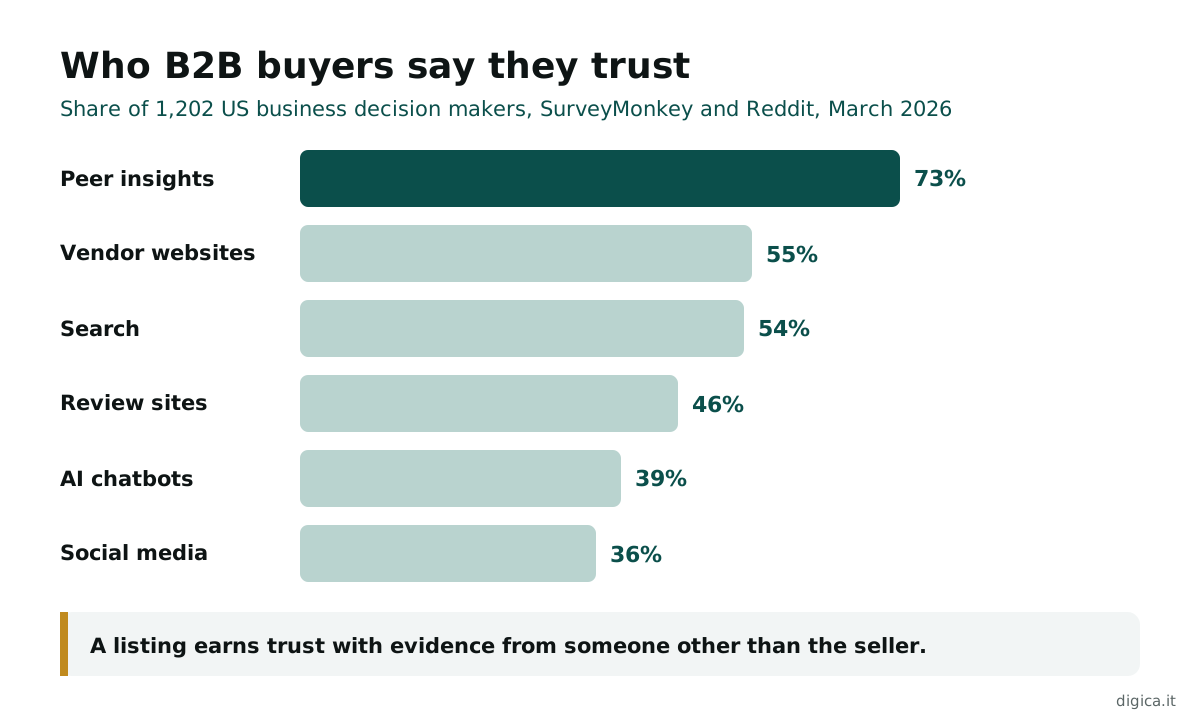
Buyers trust other buyers first and vendors less. A listing page earns trust by carrying evidence from someone other than the seller.
In a March 2026 study by SurveyMonkey and Reddit of 1,202 US business decision makers, 73% trusted peer insights, against 55% for vendor websites, 54% for search, 46% for review sites and 39% for AI chatbots. Some 48% said real user testimonials were hard to find. Reddit co-branded the study, so read the community figures with that in mind. The order still fits what we see elsewhere.
AI does not replace that order. TrustRadius found that 63% of technology buyers used AI, and that 94% of those who did fact-check its responses at least some of the time. An assistant can put a supplier on the list. Then a person looks for evidence that it belongs there, and that evidence is usually on a page like yours.
This is where a B2B marketplace has an advantage over any single vendor. It can show verification, reviews and order history that a seller cannot credibly claim about itself. It can also lose that advantage quickly. A "verified" badge that nobody can explain is worse than no badge, because the first buyer who asks what it means will find no answer. State the check, in plain words, on the page. Our guide on how to attract vendors to a B2B marketplace covers the supplier side of that bargain.
Three failure scenarios
These are the patterns that recur when operators build for transactions and ignore the journey that comes before them.
- The catalog that nobody could narrow. A B2B marketplace lists 2,000 suppliers and offers two filters, region and category. Buyers open four or five profiles, find the data does not match across them and go back to search. Traffic looks healthy and requests stay flat. Three filters based on how buyers actually decide, with the same fields on every supplier, would have kept them on the page long enough to build a list.
- The listing that convinced only the user. An engineer forwards a supplier page to procurement. It has no payment terms, no certificate and no named company details. Procurement asks for them by email, nobody replies for a week and a known vendor gets the order. A downloadable document set would have answered the question without anyone asking it.
- The growth deck built on a misquote. An operator tells prospective suppliers that 83% of B2B buyers prefer marketplaces. A procurement lead at a large supplier checks it, finds the original refers to digital commerce and starts to doubt everything else in the deck. The real data, a fast-growing channel at a small share, would have made a more believable pitch.
Each team had real traffic and real suppliers. None of them looked at the journey from the buyer's side of the screen.
Where to start: a decision framework
Start where buyers leave. Find the point where they stop moving through your pages, and fix that first.
- If fewer than 1 in 20 category page visitors opens a listing, fix the category page: filters, comparable fields and a clear explanation of the category.
- If visitors open listings but fewer than 1 in 50 send a request, fix the listing: price or a route to it, availability and proof of the seller.
- If under half of your listings have complete data in the fields buyers filter on, fix supply data before you buy more traffic.
- If requests arrive and many suppliers never reply, fix responsiveness, since no page can make up for silence.
- If your category pages do not appear when you ask an AI assistant about your category, make them easier to quote, using plain answers, dates and sources.
- If you sell mostly to procurement teams, add payment terms, documents and approved-supplier details before you add any other feature.
Want more buyers to reach your suppliers?
Our B2B marketplace demand generation work brings qualified buyers to the pages where they decide, then gives them what they need to send a request.
These thresholds are our own starting points rather than published benchmarks, and they vary by category and order size. Measure your own rates first, and judge each one against the last quarter, not against someone else's marketplace. Our guide to marketplace liquidity and the wider set of marketplace metrics show what to track once requests start to flow, so that the next round of fixes comes from your own numbers and not from a benchmark.
What a page buyers trust is worth
A better category or listing page is worth the requests it adds, without any extra traffic. The arithmetic is simple enough to check against your own numbers.
Run an illustrative case. A B2B marketplace gets 50,000 category page visits a month, with 10% opening a listing and 2% of those sending a request. That is 100 qualified requests. Lift listing opens to 12% and requests to 3%, through better filters and fuller data, and the same traffic produces 180 requests. If 10% of requests convert at an average commission of $500, monthly revenue moves from $5,000 to $9,000, about $48,000 more a year on the same traffic. The figures are illustrative, but the structure holds at most sizes.
The longer-term value is in the data those pages build. We have seen what compounding looks like on the supply side, with a B2B agency marketplace that reached 40,000+ listed agencies and 1M+ monthly users, grown from five people. Leads and organic growth come from the same engine, because the page that convinces a buyer is usually the page that ranks and gets quoted. There is room to win here: 55% of business decision makers say it is difficult to identify trustworthy sources (SurveyMonkey).
The number to take to your next planning meeting is how many of your category pages would get a supplier onto a buyer's shortlist with no call. If you do not know, read five of them as a procurement lead would. The biggest cost of doing nothing is being absent from a list that closes on day one.
FAQ
What is the B2B buyer journey? The B2B buyer journey is the path a business takes from noticing a need to buying and renewing. In practice, it runs through finding options, shortlisting, validating with a wider group and buying, and much of it now happens before anyone contacts a seller.
What are the stages of the B2B buyers journey? Most models use awareness, consideration and decision, sometimes with retention added. For a B2B marketplace, four working stages are more useful: find, shortlist, validate and buy, because each needs different information on the page.
How has B2B buyer behavior changed? Buyers do more alone. Gartner found 67% prefer a rep-free experience, and 6sense found first contact comes 61% of the way through the process. Groups are also larger, with Forrester reporting an average of 13 internal and nine external participants.
Do B2B buyers really buy through marketplaces? Some do, often, but it is still a small share of total spend. Digital Commerce 360 estimated marketplaces at 1.3% of all B2B sales in 2023. A small 2023 survey of 103 buyers found 59% conducted more than a quarter of their purchases on marketplaces.
What do B2B buyers want on a listing page? They want price or a route to it, comparable specifications, stock and delivery information, proof of who the seller is, reviews from real customers, payment terms and documents they can forward to colleagues.
How does AI change the B2B buyer journey? It changes where research starts more than what buyers trust. Gartner found 45% of buyers used generative AI on a recent purchase, while 69% prefer to validate AI-generated insights with a sales rep. Clear and well-sourced pages are more likely to be quoted.
Related Articles
- Marketplace demand generation
- B2B marketplace growth strategy: what works in 2026
- Marketplace category page SEO
- How to get cited by AI answer engines
- Vertical marketplaces: why niche B2B platforms win
- Best software review sites
Where this connects
This article is part of our B2B marketplace growth series. Browse more on the Digica blog.