AI data sourcing: how data brokers grow data acquisition and keep their suppliers
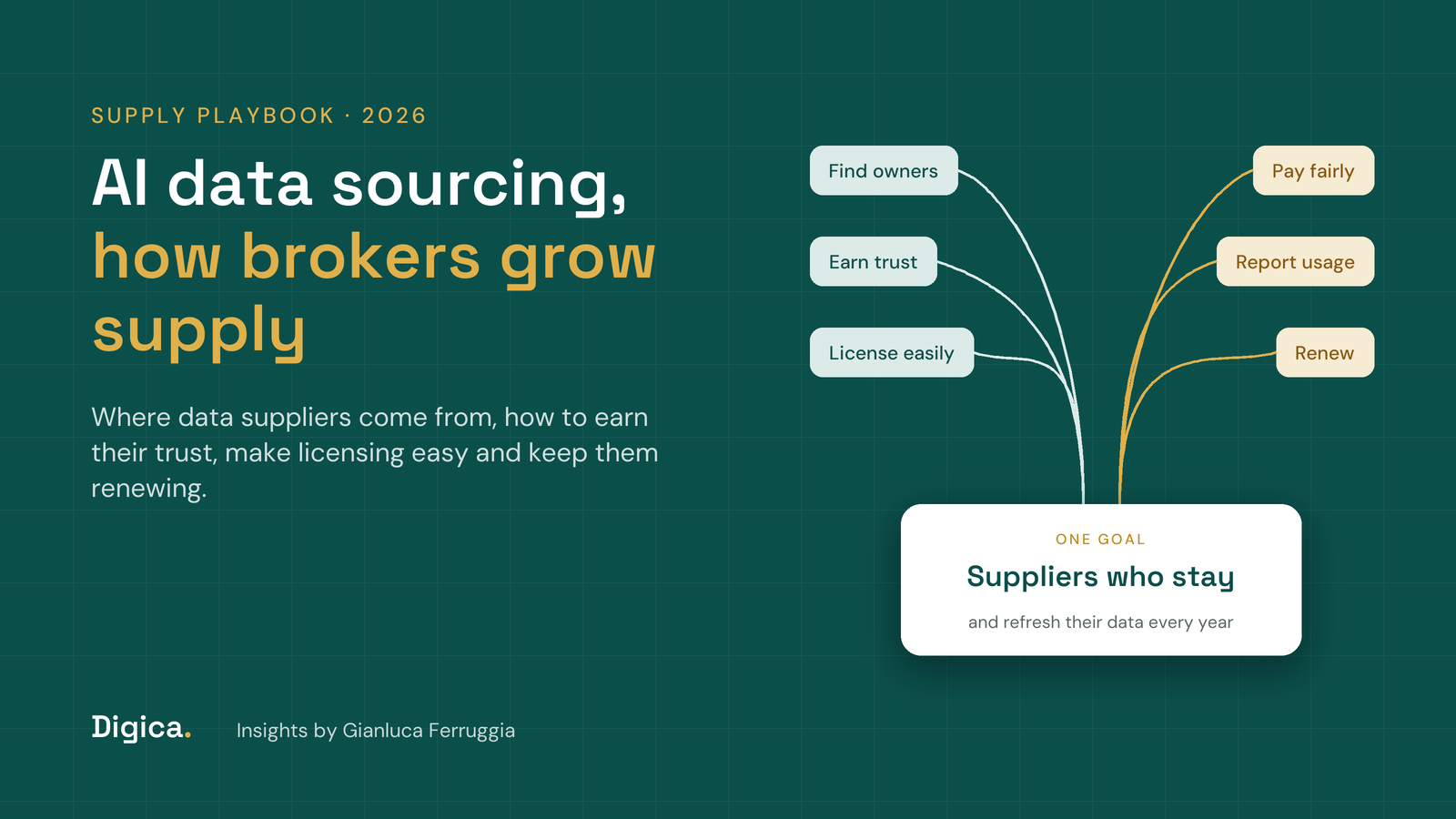
Data sourcing decides whether a data broker has anything to sell. Buyers of AI training data are easy to find in 2026. Data owners willing to license, with rights they can prove, are not. Defined.ai said its data marketplace saw a 1,200% increase in third-party partner datasets in 2025, and that several partners now earn more than $1 million a year. That growth came from recruiting suppliers, not from finding more buyers.
Most guides to data sourcing are written for the buyer: how a company gets data in. Very few are written for the broker or the data B2B marketplace that has to win the supply first. That side of the business looks like every other B2B marketplace we have worked on. The hard part is never the demand. It is convincing the right sellers that listing with you is safer and more profitable than doing nothing.
This guide is for data brokers, AI data marketplaces and companies deciding how to become a data broker. It covers where data suppliers come from, what makes them trust a broker, how to make licensing easy, how payouts keep them, and the rules to register under first. It is part 3 of our AI training data series, after the AI training data market map and the guide to selling data to AI companies.
Quick Navigation
- What data sourcing means for a broker
- Why supply is the hard side of a data B2B marketplace
- Where data suppliers come from
- How five platforms recruit data suppliers
- Earning a data owner's trust
- How to become a data broker: register before you recruit
- Payouts that keep data suppliers listing
- A data acquisition strategy that removes the work
- Data partnerships that renew
- Three failure scenarios
- Where to start: a decision framework
- FAQ
- Related Articles
What data sourcing means for a broker
The short answer: for a data broker, data sourcing is supply acquisition. It means finding organizations that hold valuable data, winning their agreement to license it, documenting the rights, and keeping them supplying fresh data after the first sale.
For a buyer, sourcing ends when the data arrives. For a broker, the first delivery is where the real work starts. A dataset sold once is a transaction. A data supplier who refreshes the dataset every quarter, adds a second one and stays for three years is a business. The difference between the two is almost entirely in how the supplier was recruited and treated.
That is why we treat broker growth as a two-sided problem with the supply side first. Buyers arrive when the catalog is worth searching. A catalog is only worth searching when the data suppliers behind it are credible, current and cleared to license. This is the same pattern we describe in how to attract vendors to a B2B marketplace, with one extra layer: every listing carries legal rights that the broker has to stand behind.
Our view: a broker that measures itself on datasets listed is measuring the wrong thing. Measure licensed, refreshed and renewed supply. A thousand stale listings sell less than fifty active data partnerships.
Why supply is the hard side of a data B2B marketplace
The short answer: most of the data that AI teams want carries restrictions, and most data owners have no process for licensing it. The broker has to solve both before a sale is possible.
Restrictions are the norm, not the exception. Researchers at the Data Provenance Initiative audited nearly 4,000 public datasets and found that while fewer than 33% were restrictively licensed, over 80% of the source content in widely used text, speech and video datasets carried non-commercial restrictions (ICLR 2025). In plain terms, much of what looks free to train on is not cleared for commercial use. That gap is the broker's opportunity, because licensed data is what AI teams can defend.
The cost of getting it wrong has a number attached. Anthropic agreed to pay $1.5 billion to settle the authors' lawsuit over books used in training, about $3,000 for each of an estimated 500,000 books, and the court granted final approval on July 20, 2026. Every AI team buying data read that settlement. It moved the conversation from "can we get this data" to "can we prove we were allowed to use it".
The owner's side has its own friction. A logistics company with ten years of shipment records, a publisher with an archive or a clinic network with de-identified outcomes rarely has anyone whose job is data licensing. Nobody inside owns the decision, so it stalls. The broker's real competitor is not another broker. It is inertia inside the data owner.
Where data suppliers come from
The short answer: data suppliers fall into five groups, and each needs a different pitch. Platforms with user content, publishers and archives, enterprises with operational data, research institutions, and individual creators.
- Platforms with user content hold the most valuable continuous data, and they know it. Reddit reported $140.0 million of other revenue in 2025, up from $114.7 million in 2024, and said the increase came from content licensing agreements executed in 2024 and 2025. These owners negotiate directly with labs and need a broker only for niche buyers.
- Publishers and archives hold large, well documented text, image and video collections. Amazon agreed to pay The New York Times a reported $20 million to $25 million a year in 2025. Smaller publishers cannot reach that table alone, which is where a broker earns its share.
- Enterprises with operational data are the largest untapped pool: transaction logs, sensor readings, call recordings and support tickets. They need the most help with de-identification and rights, and they respond best to a broker that handles compliance for them.
- Research institutions hold specialist data, such as clinical, scientific or linguistic sets, and care most about attribution and use limits.
- Individual creators, such as authors, photographers and video makers, supply at volume through opt-in programs, but each contributes a small amount.
Brokering AI training data or running a data B2B marketplace?
In 30 minutes we look at how data owners find platforms like yours, on Google and in AI answers, and which supplier group you could recruit first.
Defined.ai's partner growth and Protege's network, which it says grew to hundreds of organizations through 2025, show the enterprise and institutional groups are where broker supply is growing fastest. A useful first step is to pick two of the five groups and build the pitch, the contract and the onboarding around them, rather than recruiting everyone at once. Our data marketplace growth work starts the same way: one supplier group, one buyer group, then expand.
How five platforms recruit data suppliers
The short answer: platforms recruit data suppliers with one of three offers. Self-serve reach for a commission (Datarade), managed sales with revenue share (Defined.ai and Protege), or a low fee inside a cloud buyers already use (AWS Data Exchange and Snowflake Marketplace).
Five data platforms compared on what a data supplier gets, what it costs, the main risk and the supplier each suits
| Platform | What the supplier gets | Cost to the supplier | Trust signal offered | Main risk for the supplier | Best for |
|---|---|---|---|---|---|
| Datarade | 50k+ monthly visitors, 1k+ monthly qualified leads and data requests | $0 a year plus 30% commission, or paid plans at 20% and 15% | Application review in 1 to 2 business days | You still run each sale yourself | B2B data companies wanting broad buyer reach |
| Defined.ai | Managed sales to AI teams, average partner revenue stated at $600K+ | Commercial terms set per dataset, no published share | Partner approval on terms, ISO 27001, 27701 and 42001 | Less control over price | Owners of speech, text and image data |
| Protege | Revenue share paid with each use | Revenue share, terms not published | Handles privacy and intellectual property compliance | Terms are private and vary | Healthcare and media data holders |
| AWS Data Exchange | Access to AWS buyers and their procurement | 3% on public offers, 1.5% to 3% on private offers | AWS billing and contract templates | You market the listing yourself | Data companies already selling to enterprises |
| Snowflake Marketplace | Listings inside the buyer's own data platform, with Stripe payouts | No extra cost for the Stripe payout account, no commission published | Approved provider profile | Visibility among many listings | Data that buyers query live |
Every figure is the platform's own statement, checked on October 28, 2026. None publishes how many suppliers actually earn from each sale, so treat partner revenue claims as a ceiling, not a forecast.
The pattern is clear. The more work a platform does for the supplier, the less it publishes about the split. That is fine for a supplier who values time over margin, and a problem for one who wants to compare offers. A new broker can stand out simply by publishing its terms.
Earning a data owner's trust
The short answer: data owners trust a broker that shows them four things before they sign. Who will buy, what each buyer may do with the data, how they will be told about each use, and who carries the legal risk.
Defined.ai's partner page is a good example of the tone that works. It says commercial terms are "always aligned with and approved by the partner". That one phrase answers the owner's biggest fear, which is losing control of the asset once it leaves the building. Approval rights on each buyer type, such as model training, evaluation or retrieval, cost the broker little and remove the main reason to say no.
Usage reporting is the second trust signal, and the one most brokers skip. An owner who licenses an archive wants to know which buyers used it, for which purpose and what it earned. Protege pays revenue share with each use, which only works if each use is recorded. A monthly statement per dataset, showing buyer type, purpose and payout, does more for supplier retention than any rate improvement.
Certifications and compliance handling come third. Defined.ai cites ISO 27001, 27701 and 42001. Protege handles privacy and intellectual property compliance, including de-identified clinical records. For an enterprise owner, a broker that takes on the compliance work is buying their time back, and the legal team is usually the one that has to approve the deal.
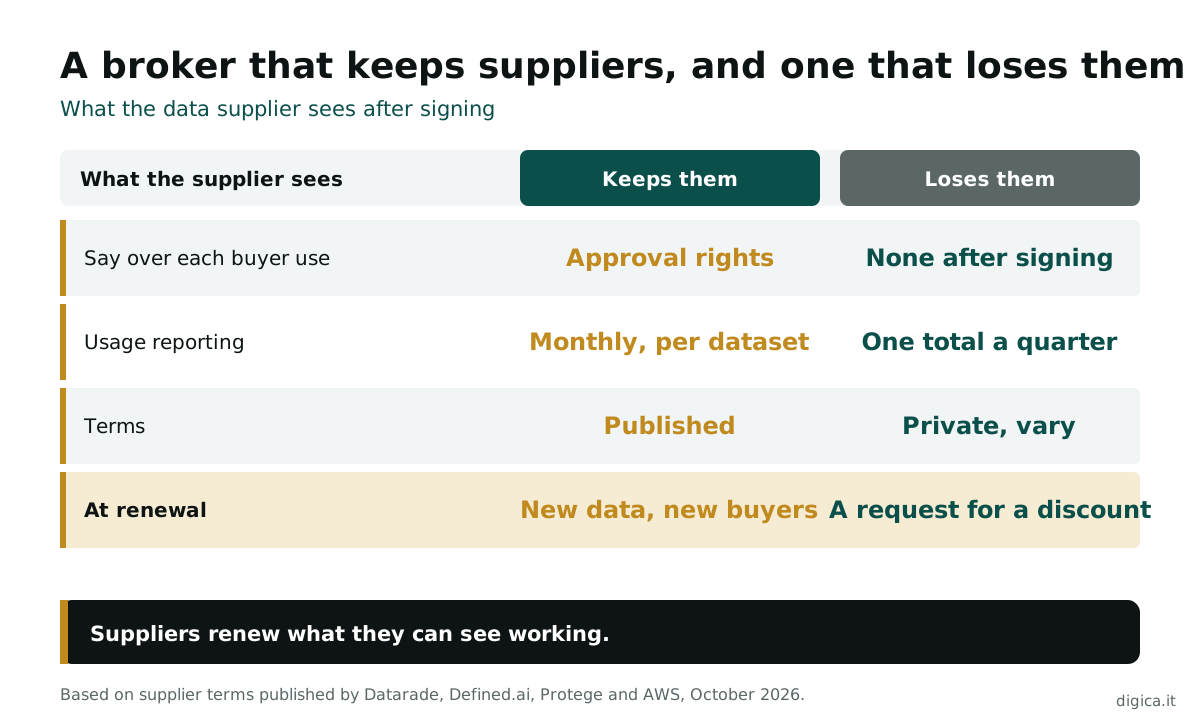
Our view: trust is the product a data broker sells to suppliers. That is backwards. A buyer can choose among many datasets, but a supplier with good data can choose among many brokers, and the one it picks is the one that made it feel safe first. Data is what it sells to buyers. Most brokers spend their effort on the buyer pitch and lose suppliers on the trust pitch.
How to become a data broker: register before you recruit
The short answer: in the United States, a business that sells personal information about people it has no direct relationship with is likely a data broker under state law, and must register before it trades. Check this before you recruit a single supplier.
California is the reference point. The California Privacy Protection Agency's 2026 Data Broker Registry lists businesses that operated as data brokers in 2025 (CalPrivacy). The registry's download file holds 603 entries, up from 543 in the 2025 file, by our count. Since January 1, 2026, California residents can send one deletion request to every registered data broker through the Delete Request and Opt-out Platform, and brokers had to begin processing those requests from August 1, 2026.
That matters for AI data sourcing even when the data is not about consumers. A dataset of call recordings, support tickets or location traces can hold personal information. A broker that recruits that supply without a registration and deletion process inherits the owner's risk and adds its own. A broker that has the process can offer it as part of the pitch: we take on the compliance work so you do not have to.
The practical order for anyone deciding how to become a data broker is short. Decide which data types you will accept. Check whether any contain personal information and which state laws apply. Register where required. Write the deletion and opt-out process. Only then publish the supplier offer. Brokers that reverse the order spend their first year unwinding deals.
Payouts that keep data suppliers listing
The short answer: data suppliers stay when payouts are frequent, explained and growing. The split matters less than most brokers think, as long as it is published and paid on time.
Look at how Datarade structures it. A supplier can start at $0 a year plus 30% commission, move to $6,000 a year plus 20%, or $12,000 a year plus 15%. On $100,000 of annual sales, the free plan costs $30,000 in commission, the $6,000 plan costs $26,000 in total and the $12,000 plan costs $27,000. The ladder rewards suppliers for growing, which is exactly the behavior a broker wants. At the other end, AWS Data Exchange charges 3% on public offers and 1.5% to 3% on private offers by contract size, with renewals at 1.5%. A low fee there reflects a low service level: AWS bills the buyer, and the supplier does the selling.
Do data owners find your platform when they look for a buyer?
A growth audit maps how data owners and AI teams search for data brokers and data marketplaces, on Google and in AI answers, and which of your supplier pages they never reach.
Two payout models work best for AI training data. A flat license fee per dataset suits owners who want a predictable number for their finance team. A revenue share paid with each use, as Protege offers, suits owners who believe their data will be used many times. Offer both, and let the owner choose. The choice itself builds trust.
Payment timing is where brokers lose suppliers quietly. A supplier waiting 90 days for a payout from a sale they never saw starts to wonder whether the sale happened. Monthly payouts with a statement per dataset remove that doubt. Defined.ai reported 65% year-over-year revenue growth in 2025, and its pitch to partners leads with what partners earn, not with the size of its catalog. That is the right order.
A data acquisition strategy that removes the work
The short answer: the best data acquisition strategy makes licensing take less effort than ignoring the request. Standard contracts, a provenance template, a de-identification service and a named contact cut most of the delay.
Start with the contract. A data owner's legal team will not read a bespoke 40-page agreement for a first deal worth less than their annual software budget. A standard license with three choices, training, evaluation or retrieval, plus exclusive or non-exclusive and a fixed term, can be approved in a week. Keep the custom terms for the largest suppliers.
Then make provenance easy. Since July 2025 the European Commission has published a template that providers of general-purpose AI models use for the public summary of their training content, and licensed data is one of the source types it asks about. Buyers now need documentation they can drop into that summary. A broker that collects source, date range, consent basis and rights holder at onboarding, in the shape buyers need, saves both sides weeks.
Finally, give every new supplier one named person and a first payout target. Our marketplace vendor onboarding research applies directly here: listed is not live. A supplier who has signed but not delivered is a cost. A supplier who has delivered, been paid and seen a statement is supply. Across the six data rankings we have published this year, we named 38 different data companies. The ones that grew fastest were not the ones with the most listings. They were the ones that made it easy for owners to start.
Data partnerships that renew
The short answer: data partnerships renew when the supplier earns more in year two than in year one, and can see why. That needs fresh data, new buyer types and reporting that shows both.
AI teams pay most for data that keeps arriving. Reddit's licensing revenue rose year on year because its deals cover continuous access, not a one-off file. A broker should ask every supplier the same question at the first renewal: what new data have you created since we started, and can we add it to the license? A refresh clause, written into the first contract, turns a one-off sale into a subscription.
New buyer types are the second lever. A dataset licensed for training can often be licensed again for evaluation or for retrieval, on separate terms. Each new use is a reason to call the supplier with good news, which is the opposite of the renewal call most brokers dread.
Growing the supply side of a data B2B marketplace?
We help data brokers and data marketplaces recruit the data owners that make a catalog worth buying from, and reach the AI teams searching for it.
The same principle holds outside data. In one SaaS partner and referral program, 94% of referred SaaS accounts are still active after onboarding, because partners were shown what each referral produced. Retention follows reporting. A supplier who can see the value renews without a discount. One who cannot see it asks for a better split at every renewal, and eventually tests a rival broker with part of the catalog.
Three failure scenarios
These are the patterns that recur when brokers grow supply without a plan.
- The catalog built on unclear rights. A new AI data broker signs forty suppliers in six months by accepting any dataset with a signed upload form. The first large buyer asks for provenance on every file. Half the suppliers cannot provide it, and the deal shrinks to a pilot. The buyer needs that provenance for the training content summary the European Commission's template asks for (European Commission). Accepting fewer suppliers with documented rights would have closed the full deal.
- The silent payout. A broker pays quarterly with a single total and no breakdown. Suppliers cannot see which buyers used their data, assume they are underpaid and stop sending refreshes. Monthly statements per dataset would have kept them supplying for the cost of a report.
- The supplier offer nobody can find. A data marketplace has strong terms but only a contact form for data owners. Owners searching for a data supplier program, or asking an AI assistant who buys data, find two competitors instead. A published supplier page, with terms, examples and a two-step application, would have put it on the shortlist.
Each broker had buyers waiting. Each lost supply it could have kept. Supply problems in a data B2B marketplace almost always start before the first contract is signed.
Where to start: a decision framework
The short answer: pick the supplier group you can serve best, publish terms for it, and measure renewed supply rather than listings.
- If any data you accept may contain personal information, register where state law requires and publish a deletion process before you recruit.
- If fewer than 20 suppliers are live, recruit from one supplier group only, with one standard contract.
- If more than 30% of signed suppliers have not delivered within 60 days, fix onboarding before recruiting more.
- If you pay less often than monthly, move to monthly payouts with a per-dataset statement.
- If your terms are not published, publish them, even as a range. Owners compare before they call.
- If fewer than half of suppliers refresh their data each year, add a refresh clause and a new buyer type at renewal.
- If data owners cannot find your supplier page on Google or in AI answers, build it before spending on outbound.
The number to take into your next board meeting is the share of suppliers who renew with fresh data. A broker with 50 suppliers that each refresh once a year sells new data every week. A broker with 500 suppliers that never refresh sells a catalog that ages every day. For example, 50 suppliers each renewing a $20,000 yearly license is $1 million of repeat supply revenue before a single new supplier is signed. The biggest cost of doing nothing is a supply base that looks large on the website and earns less each quarter.
FAQ
What is data sourcing? Data sourcing is the process of finding, acquiring and documenting data from outside an organization. For a buyer it means getting data in. For a data broker or data marketplace it means recruiting data suppliers, clearing the rights and keeping them supplying.
How do data brokers find data suppliers? Most recruit from five groups: platforms with user content, publishers and archives, enterprises with operational data, research institutions and individual creators. The fastest-growing brokers focus on one or two groups, publish clear terms and handle compliance for the owner.
How do you become a data broker? Decide which data types you will accept, check whether any contain personal information, and register under state laws such as California's where they apply. Then write a deletion and opt-out process, a standard license and a supplier offer before you recruit.
What is a data acquisition strategy? A data acquisition strategy sets which data a broker or AI team will acquire, from which suppliers, on what terms and with what documentation. For a broker, it should also cover payouts, reporting and renewal, because those decide whether suppliers stay.
How much do data marketplaces charge data suppliers? It varies by model. Datarade offers a free plan at 30% commission and paid plans at 20% and 15%. AWS Data Exchange charges 3% on public offers and 1.5% to 3% on private offers. Managed brokers such as Protege pay a revenue share that is not published.
What makes a good data partnership? A good data partnership gives the owner approval over how the data is used, regular payouts with a statement per dataset, and a reason to renew, such as a refresh clause or new buyer types. Clear rights documentation protects both sides.
Related Articles
- AI training data market: who buys, who sells, who wins
- How to sell data to AI companies: a licensing guide
- Best data marketplaces in 2026
- Best places to sell data in 2026: brokers and platforms
- B2B marketplace growth strategy: what works in 2026
Where this connects
This article is part of our B2B marketplace growth series. Browse more on the Digica blog.