Marketplace fees and take rates: B2B benchmarks from 27 published price lists
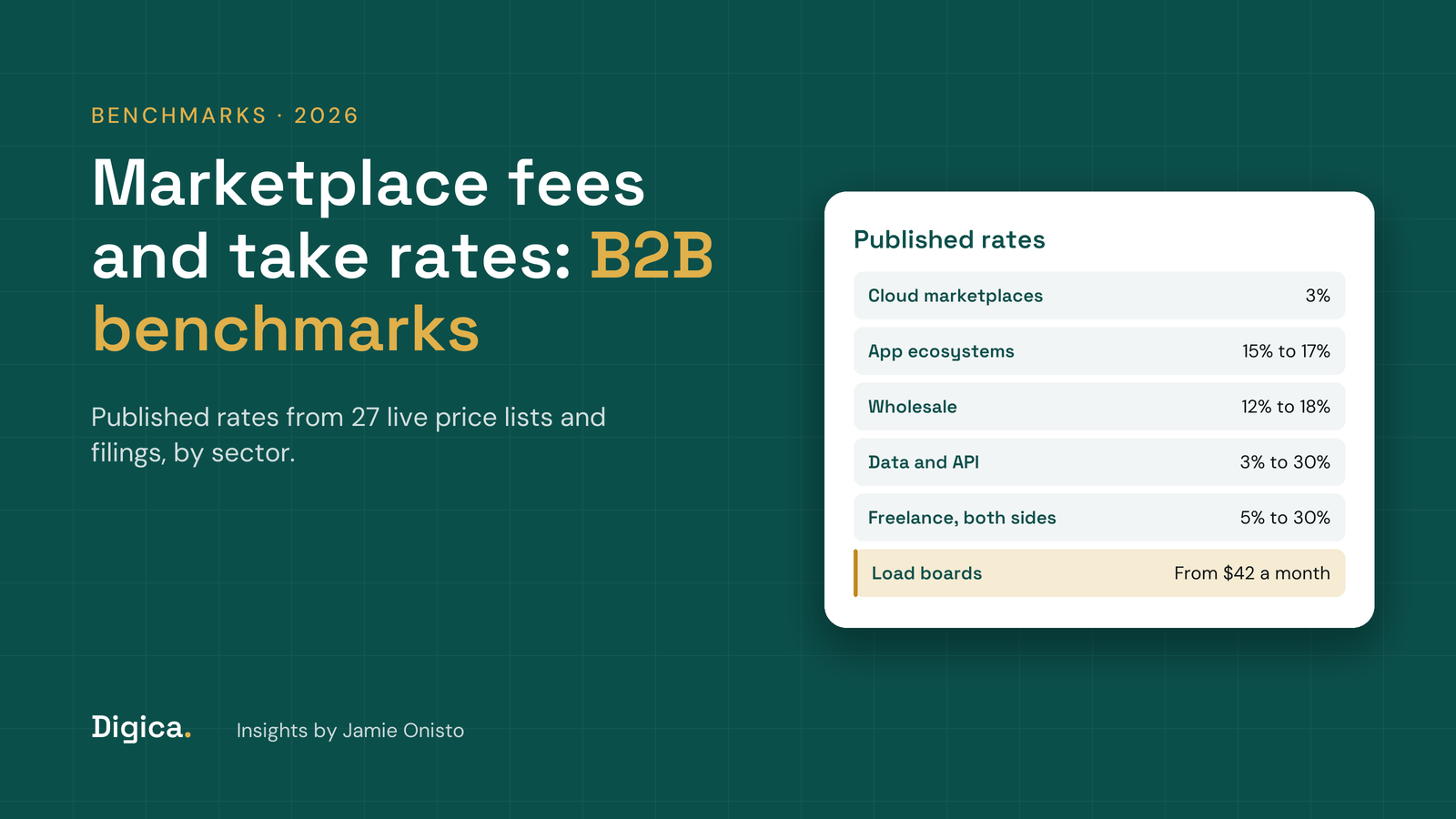
Marketplace fees are the price a B2B platform puts on its own usefulness, and the published numbers run from 1.5 percent to 30 percent. A software vendor pays AWS 3 percent on a SaaS deal, and a data seller on a commission-only plan pays Datarade 30 percent. Founders who set a fee by copying "the industry average" are copying a number that does not exist.
We checked this ourselves. Across the 58 industry rankings we had published by November 6, 2026, naming 338 companies, our own write-ups record a fee, price or free tier for only 94 of them, about 28 percent. That counts what we wrote, not what each platform publishes. So we went back to the sources, read the current price lists and filings, and built the benchmark we wanted to use.
This guide gives marketplace fees and take rates for 27 platforms across eight sectors, with the sector ranges, the take rates that filings imply, and how fees change on renewals, on large deals and on repeat business. It is written for founders setting or revisiting a price. It does not repeat the fee models themselves, which our guide to marketplace business models covers, or how to build a pricing plan, which is the work of our B2B marketplace monetization service. Every rate was checked on November 6, 2026.
Quick Navigation
- How we built these marketplace fee benchmarks
- Marketplace fees by sector, side by side
- Why software fees split into 3 percent and 15 percent
- Why data and freelance fees run highest
- Marketplace take rate in filings: what companies really keep
- Who pays: supply, demand or both
- How fees fall on repeat business and large deals
- When a subscription beats a commission
- What a take rate has to pay for
- Three failure scenarios
- Testing your fee against the benchmarks
- What one point of take rate is worth
- FAQ
- Related Articles
How we built these marketplace fee benchmarks
The short answer: we took the published list price of 27 platforms, on the live page or filing, and recorded the rate a new participant pays. These are not negotiated rates, and large accounts often pay less.
We started from the platforms in our own rankings, then added well-known examples where a sector was thin. We left out any rate that we could not read on a primary source today. That removed a number of platforms whose fee pages block automated readers, and others whose only evidence was a search summary. So this is not a random sample, and a few of these platforms also serve small or individual sellers.
Three rules keep the sector comparison honest. We use one value per platform, the standard headline rate. Where both sides pay, we add the two percentages. And we give ranges wherever the sample is small, because a median of two or three platforms means little. For the definition of take rate and how it relates to gross merchandise value, see our guide to marketplace metrics.
Our view: a fee is a claim about value. The list price tells you what a platform believes it is worth to the side paying it. That makes these rates useful evidence, even though they do not show what anyone negotiated.
Marketplace fees by sector, side by side
The short answer: 19 of the 27 platforms charge a percentage, and eight charge a subscription, a flat fee or a per-unit price. The pattern by sector is far clearer than any single average.
Marketplace fees on 27 B2B platforms by sector, with fee model, published rate, who pays and the main caveat
| Sector | Platform | Model | Published rate | Who pays | Caveat |
|---|---|---|---|---|---|
| Software | AWS Marketplace | Seller fee | SaaS 3%, server 20% | Seller | 1.5% on all private offer renewals |
| Software | Microsoft Marketplace | Seller fee | 3% | Publisher | 50% off on private offer renewals |
| Software | Google Cloud Marketplace | Revenue share | 3%, down to 1.5% | Vendor | By deal size and renewal |
| Software | Salesforce AppExchange | Royalty | Typically 15% | Partner | Some apps pay a flat fee |
| Software | Shopify App Store | Revenue share | 0% to $1M lifetime, then 15% | Developer | 2.9% processing on top |
| Software | Atlassian Marketplace | Revenue share | Forge 17%, Connect 25% | Partner | 0% on Forge to $1M lifetime |
| Data, API | AWS Data Exchange | Seller fee | 3% | Provider | Private tiers apply |
| Data, API | Apify Store | Commission | 20% | Developer | Usage costs also deducted |
| Data, API | Rapid API Hub | Commission | 25% | Provider | Payout fees are separate |
| Data, API | Datarade | Commission or plan | 30%, 20% or 15% | Provider | Lower rates need a plan |
| Data, API | Opendatabay | Sliding commission | 30% down to 5% | Provider | Listing is free |
| Freelance | Upwork | Both sides | Talent 0% to 15%, client 5% | Both | Talent rate fixed per contract |
| Freelance | Freelancer.com | Both sides | 10% plus 3% | Both | Dollar minimums apply |
| Freelance | Braintrust | Client fee | 15% | Client | Conversion fee on direct hire |
| Freelance | PeoplePerHour | Both sides | Client 10%, talent 20% to 3.5% | Both | Talent rate falls per buyer |
| Freelance | Contra | Flat client fee | $15 or $29, or $0 on Pro | Client | Its help pages show differing schedules |
| Wholesale | Amazon seller pricing | Commission | 12% on industrial supplies | Seller | General schedule, plus a plan |
| Wholesale | Pod Foods | Commission | 18% or 8% | Brand | By service level |
| Wholesale | Ankorstore | Commission | 0% on reorders | Brand | First order rate not published |
| Wholesale | Alibaba.com | Membership | 0% on offline orders | Supplier | Priced by region |
| Auctions | Ritchie Bros. | Buyer fee | 10% to $30,000, then lower | Buyer | Seller rates not published |
| Logistics | DAT One | Subscription | From $59 a month | Carrier, broker | Brokers from $159 |
| Logistics | Truckstop | Subscription | $42 to $299 a month | Carrier | No percentage on loads |
| Energy | Nord Pool | Access plus per unit | About $23,000 a year | Member | Plus a fee per MWh |
| Directories | Breef | Flat plus commission | Client $199, agency 15% | Both | Client fee varies by plan |
| Directories | G2 | Subscription | $299 a month, then $599 | Vendor | Free profile available |
| Directories | Clutch Network | Free | $0 to join and use | Neither | Sponsorship is separate |
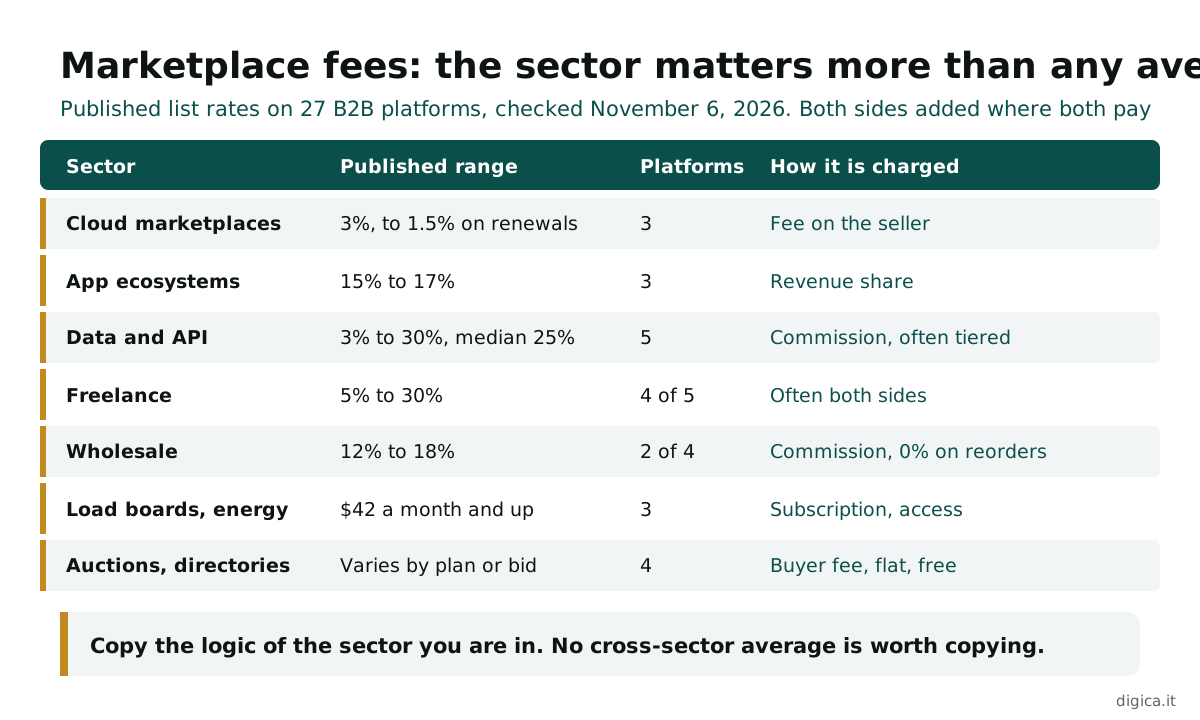
On the percentage platforms, the sectors read like this. Software splits into two groups, covered below. Data and API platforms run from 3 to 30 percent, with a median of 25 across five. Freelance runs from 5 to 30 percent across four once both sides are added, with a median between 14 and 17.5, because Upwork's talent fee varies. Wholesale runs from 12 to 18 percent on two, or 8 percent on Pod's direct service. We would not state a cross-sector median, since it would blend 3 percent cloud fees with 30 percent data commissions into a number nobody charges.
Why software fees split into 3 percent and 15 percent
The short answer: there are two different businesses here. Cloud marketplaces charge about 3 percent, and app ecosystems charge 15 to 17 percent once a developer is past the free band.
AWS lists 3 percent on SaaS public offers, with private offers at 3 percent below $1 million, 2 percent from $1 million and 1.5 percent from $10 million (AWS). Microsoft charges a 3 percent standard store service fee, and Google lists the same 3 percent to 1.5 percent shape. Three competitors landing on the same number is unusual, and it suggests that the fee is not what they are competing on.
App ecosystems are different. Salesforce says its royalty is typically 15 percent of an app's revenue. Shopify takes nothing on a developer's first $1 million of lifetime revenue and 15 percent after that, while Atlassian's partners keep 83 percent on Forge apps from October 1, 2026, and 75 percent on Connect apps.
Not sure your fee matches your value?
In 30 minutes we look at what your B2B marketplace charges, what each side gets for it and where supply or demand is pushing back.
Our reading, and it is an inference: a hyperscaler already owns the buyer relationship, the committed budget and the invoice, so the fee is a small toll on spend it wants to keep inside its own cloud. An app ecosystem creates the distribution itself, so it charges for that. If you are a founder pointing at 3 percent as proof that fees should be low, check whether you own a buyer's budget in the way a hyperscaler does. Almost nobody does.
Why data and freelance fees run highest
The short answer: these are the sectors where the platform does the most to create a sale that would not otherwise happen, and where buyers are the hardest to find. Commission rates of 20 to 30 percent are normal for a new seller here.
Rapid API Hub moved to a 25 percent fee on all payments from November 15, 2025, and says that the fee covers payment processing, infrastructure and administration. Apify keeps 20 percent of an Actor's revenue. On commission-only terms, Datarade and Opendatabay both start at 30 percent, as our guide to the best data marketplaces sets out. AWS Data Exchange at 3 percent is the exception, and it follows the cloud logic above.
Freelance is the only sector here where platforms publish a percentage on both sides. Upwork charges talent a fixed rate per contract from 0 to 15 percent on contracts formed since May 2025, plus 5 percent to the client. Freelancer.com lists 10 percent on the freelancer and 3 percent on the employer. PeoplePerHour charges the buyer 10 percent, and the freelancer 20 percent on lower lifetime billings with a buyer. Our guide to the best freelance marketplaces compares what each side gets for that.
High rates do come with pressure. Fiverr names users going around its fees as a risk in its annual filing, and platforms in this sector also write conversion fees into their terms. The high percentage is also the reason for the leak. A rate that makes sense on a first job looks expensive on the tenth job with the same client.
Marketplace take rate in filings: what companies really keep
The short answer: reported take rates in 2025 ran from about 11 percent to nearly 28 percent, but each company's number means something a little different. Check the denominator before you benchmark against one.
Fiverr reported a marketplace take rate of 27.7 percent in 2025, on $297.5 million of marketplace revenue and $1,073.0 million of marketplace gross merchandise value. Upwork reported 18.7 percent, up from 18.0 percent, measured against Marketplace gross services volume, which is smaller than its total gross services volume.
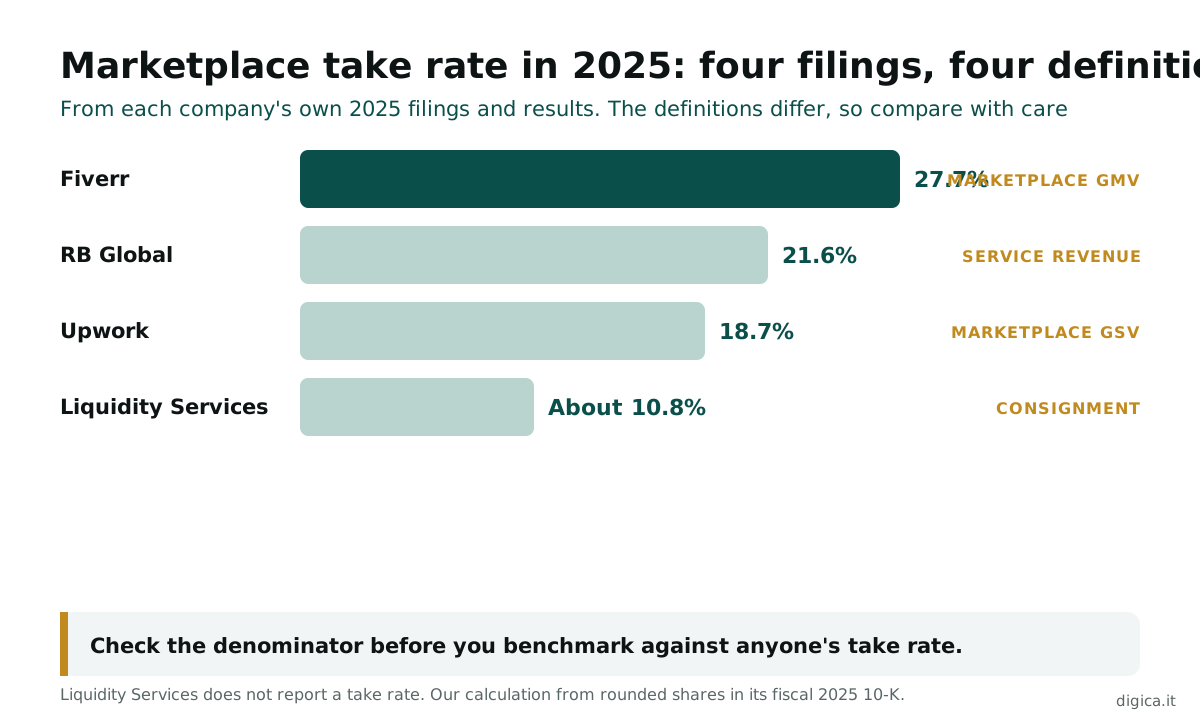
Physical goods tell a more interesting story. RB Global reported a service revenue take rate of 21.6 percent in 2025, up 50 basis points, on service revenue of $3,502.2 million and gross transaction value of $16,201.9 million (RB Global). That is high for heavy equipment, and it is earned with inspection, transport, title and financing, not only a listing. RB Global includes automotive in that total, so it is not a pure equipment number.
Liquidity Services, the lowest bar in the chart, is our own calculation rather than a reported figure, and we show the working at the end of this guide. The company does not report a take rate. That is the wider point: two of these four numbers count only part of the business, so none can be lifted straight into your own model.
Who pays: supply, demand or both
The short answer: suppliers usually pay. Of the 19 percentage platforms in this set, 14 charge only the supply side, two publish a percentage only on the demand side and three publish percentages on both.
The three that publish both are all in freelance: Upwork, Freelancer.com and PeoplePerHour. The two that publish only a demand-side rate are Braintrust, which puts its 15 percent on the client, and Ritchie Bros., which publishes a buyer fee but not its seller commissions. Breef sits in the middle, with the client paying a flat fee and the agency paying 15 percent.
This is a pattern in one dataset rather than a law. Our reading is that platforms charge the side that has fewer alternatives, and the side that finds it easiest to pass the cost on. That is why the choice matters. Charging the wrong side does not just shift revenue around. It can slow the very side you most need to grow, and our guide to two-sided marketplaces covers how that plays out.
How fees fall on repeat business and large deals
The short answer: the list price is the top of a curve. Published rates fall with renewals, with repeat relationships and with deal size, across very different sectors.
Renewals come first. AWS charges 1.5 percent on all private offer renewals, Google lists 1.5 percent on native renewals, and Microsoft offers a 50 percent discount on private offer renewals. On repeat business, Ankorstore charges 0 percent commission on all reorders, and PeoplePerHour's freelancer fee falls from 20 percent to 7.5 percent and then to 3.5 percent as lifetime billing with a buyer rises.
Size has the same effect. Opendatabay's commission falls from 30 percent to 5 percent above $250,000. Ritchie Bros. charges a buyer 10 percent on bids up to $30,000, 5.5 percent up to $75,000 and a flat $4,125 above that, which works out at 2.1 percent on a $200,000 machine and 0.8 percent on a $500,000 one.
Our view: these schedules concede something true. The second deal needs the platform less than the first, and a percentage that makes sense at $100 is hard to defend at $1 million. A flat commission on repeat business is a bet that you add value every time. If you cannot show that you do, expect the deal to move off the platform.
When a subscription beats a commission
The short answer: a subscription works when the platform cannot see the transaction, or when sellers are big enough to prefer a known cost. Eight of the 27 platforms here do not lead with a percentage.
Load boards are the clearest case. DAT One's carrier plans start at $59 a month, and Truckstop runs from $42 to $299 a month, with no percentage on loads, because a load is often agreed by phone. Alibaba.com states a 0 percent commission on offline orders and sells regional membership instead. Our guide to the best load boards compares what those plans include.
Datarade publishes the trade-off directly, and it is a useful model: commission-only at 30 percent with no fee, $6,000 a year at 20 percent, and $12,000 a year at 15 percent. From those prices we can calculate the break-even. The $6,000 plan pays back above $60,000 of annual sales, which is $6,000 divided by 10 points. The $12,000 plan beats commission-only above $80,000, and beats the lower plan above $120,000.
Does your fee reflect the demand you bring?
A growth audit maps how buyers and suppliers find your B2B marketplace, on Google and in AI answers, and how much of that demand you could actually charge for.
That sum is the tool to borrow. Divide the subscription price by the commission points it saves, and you have the sales level at which a seller should move up. It also tells you whether your best sellers have any reason to stay on commission. If most of them are past the break-even, you have a pricing page that is working against you.
What a take rate has to pay for
The short answer: before any margin, a take rate funds payments, disputes, support, supply acquisition and the cost of winning demand. List those costs first, then look at what your percentage leaves behind.
Payments are the quickest test. Shopify passes on a 2.9 percent processing fee separately from its revenue share. At that rate, a $50,000 invoice paid by card costs $1,450, which is almost the entire amount of a 3 percent marketplace fee. This is why low-fee platforms steer buyers towards bank transfers or an existing invoice: Upwork takes two points off its client fee for ACH payments, at 3 percent rather than 5.
The rest depends on the work you do. RB Global's take rate is high because its service revenue includes marketplace services such as transport, refurbishment, financing, data and appraisal. A directory or a listings platform does less in each deal, and so it usually charges for visibility instead, as G2 does with its $299 a month Starter plan.
In our own work, including on a B2B agency marketplace that grew from five people to 40,000+ listed agencies and 1M+ monthly users, the fee conversation goes better once the platform can show the leads it delivers. A price that sellers resent is often a measurement problem first. Our guide to liquidity explains why the match matters more than the rate.
Three failure scenarios
These patterns recur when founders set a fee from a benchmark alone. The dollar figures are illustrative.
- The 3 percent founder. A founder of a niche B2B marketplace sets a 3 percent fee because the cloud marketplaces charge that. Card costs absorb almost all of it, and the business earns about $1,000 on $1 million of volume. A 15 percent fee on the sellers who get new customers, with a lower rate on repeat orders, would have been defensible and would have paid for support.
- The flat rate that taught sellers to leave. A platform charges 20 percent on every order, including the fifth order from the same buyer. Its best sellers start invoicing directly after the first deal. Volume looks healthy for a year, then repeat revenue falls away. A fee that falls on repeat business, like those in the table above, would have kept those orders visible.
- The subscription that hid the winners. A directory moves everyone to a $5,000 annual plan, with no volume data at all. Sellers who win business stay, and everyone else churns at renewal. Nobody can show what the plan is worth, since the platform never sees a deal. A simple way of tracking leads would have supported both the price and the renewal.
Each founder chose a real model used by a real platform. None of them checked whether their own platform did the work that justified that price.
Testing your fee against the benchmarks
The short answer: compare your rate with your sector's range, then with the work you do in each deal. These checks test a fee you already have. Building the pricing itself is a bigger job, which our monetization team does with clients.
- If you are a software marketplace below 10 percent and do not own the buyer's budget, you may be underpricing. App ecosystems publish 15 to 17 percent.
- If you are above 25 percent on a new seller, make sure you are bringing buyers the seller could not reach alone. That is what data and API commissions at this level rely on.
- If a card fee takes more than a third of your take rate, steer buyers towards bank transfer, as Upwork does.
- If more than half of your volume is repeat business between the same two parties, publish a lower repeat rate before those parties work out how to leave.
- If you cannot see most transactions, price by subscription or lead, and report the value you deliver.
- If your largest deals pay the same percentage as your smallest, add a tier or a cap above a set value, for example $1 million.
Want a pricing model built around your B2B marketplace?
We work with B2B marketplaces on commissions, subscriptions, lead fees and paid profiles, charged once a category is liquid enough to support them.
These thresholds are starting points, and they should move with your data. Our B2B marketplace growth strategy covers how the fee fits with supply and demand as a whole. Write down which of these checks applied when you set your price, then review them after each year of data, so you can see what the change actually did and whether either side of your B2B marketplace pushed back.
What one point of take rate is worth
The short answer: on $100 million of annual volume, one point of take rate is worth $1 million a year. A small percentage change matters more than most growth projects, and it can also cost you more.
Run an illustrative case. A B2B marketplace with $100 million of annual volume charges 5 percent and earns $5 million. If it adds a service that sellers value and lifts its rate to 7 percent on the same volume, revenue rises to $7 million. If that same change drives away 10 percent of volume, it earns $6.3 million, so the increase still pays. At a 30 percent loss of volume, it earns $4.9 million, which is less than it started with. The figures are illustrative, but the sum is the one to run first.
Filed numbers show the same lever working in both directions. RB Global added 50 basis points of take rate on $16.2 billion of volume in 2025, which is worth about $81 million a year on our arithmetic. Fiverr's take rate rose slightly to 27.7 percent while its marketplace volume fell 2.2 percent, and marketplace revenue fell with it.
Read any ratio with care before you run this sum on it. Liquidity Services' total revenue of $476.7 million on $1.57 billion of gross merchandise value looks like 30 percent, but its purchase model books goods at their full sale price. Using only consignment, which was 29.0 percent of revenue and 81.3 percent of volume in fiscal 2025, we calculate about 10.8 percent, from rounded shares (Liquidity Services 10-K).
The number to take to your next board meeting is your take rate on repeat business, set against your take rate on first orders. If you cannot separate them, you cannot tell whether your fee is paying for new demand or taxing old relationships. The biggest cost of doing nothing is a fee that seemed fine at launch, while your best sellers quietly work out how to avoid it.
FAQ
What are typical marketplace fees for B2B platforms? It depends on the sector. In our set of 27 published price lists, cloud marketplaces charge about 3 percent, app ecosystems 15 to 17 percent, data and API platforms 3 to 30 percent, and freelance platforms 5 to 30 percent across both sides. Load boards and directories mostly charge subscriptions.
What is a good marketplace take rate? There is no single good rate. Reported figures for 2025 include Fiverr at 27.7 percent, RB Global at 21.6 percent and Upwork at 18.7 percent, each with its own definition. A good rate is one that sellers still accept on repeat business.
How is marketplace take rate calculated? Take rate is marketplace revenue divided by gross merchandise value over the same period. Check the definition before comparing: Upwork divides by Marketplace gross services volume rather than total volume, and RB Global uses service revenue only.
Do buyers or sellers pay marketplace fees? Usually sellers. Of 19 percentage platforms in our set, 14 charge only the supply side, two publish a rate only on the demand side, and three publish rates on both sides. All three of those are freelance platforms.
How do B2B marketplaces make money besides commission? Through subscriptions, memberships, access fees, per-unit fees and paid placement. Truckstop runs from $42 to $299 a month, G2 starts at $299 a month and Nord Pool combines an annual access fee with a charge per MWh.
Should a B2B marketplace charge a commission or a subscription? Commission fits when the platform can see the transaction and creates the sale. Subscription fits when deals close off the platform, or when sellers want a known cost. Many offer both, such as Datarade, whose plans cut commission from 30 to 15 percent.
Related Articles
- B2B marketplace monetization
- B2B marketplace growth strategy: what works in 2026
- Marketplace business models: how B2B platforms make money
- Marketplace metrics: GMV, take rate and core KPIs
- Vertical marketplaces: why niche B2B platforms win
- Best surplus and used industrial equipment marketplaces
Where this connects
This article is part of our B2B marketplace growth series. Browse more on the Digica blog.